

Ruto Unveils Sweeping Infrastructure, Housing And Economic Transformation Agenda
News Updated: 29 May 2026 22:21 EAT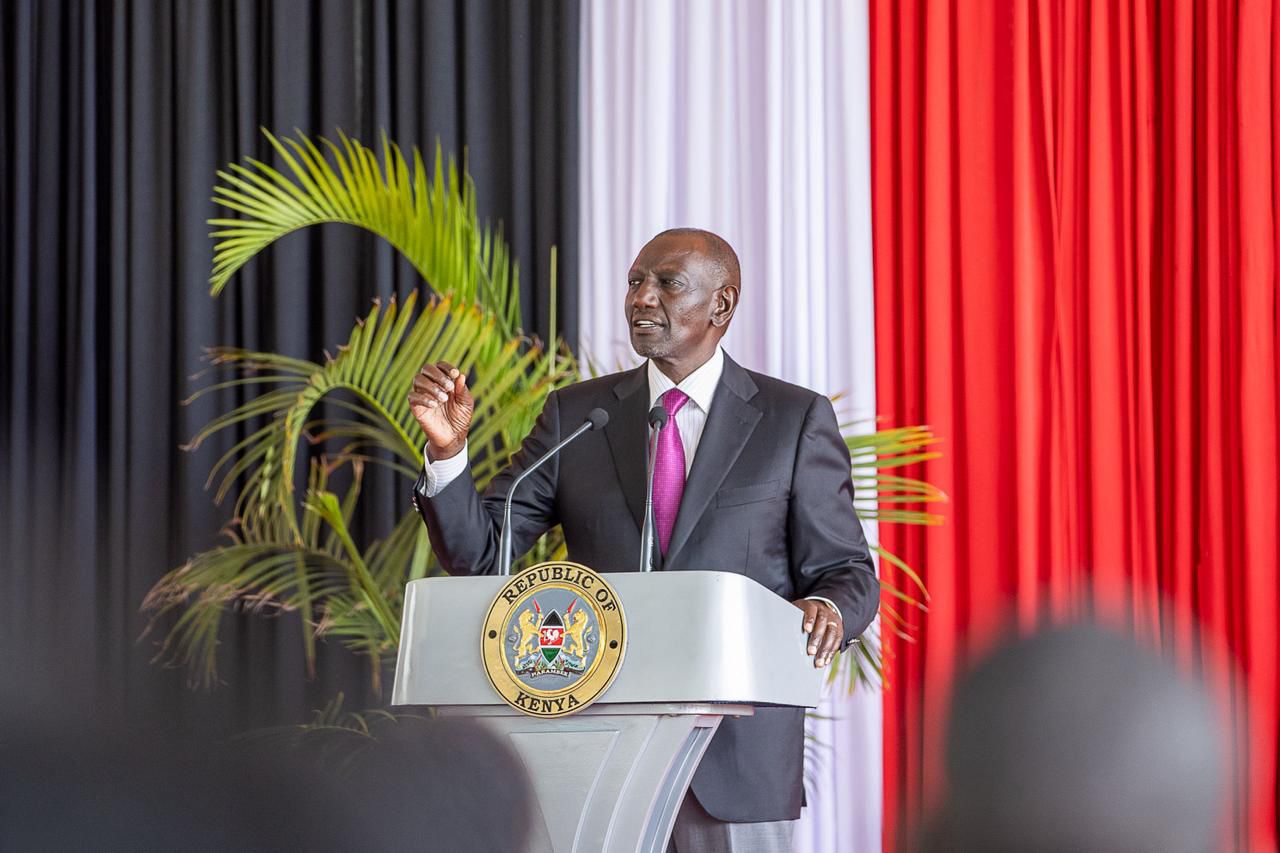
President William Samoei Ruto speaking when he met representatives of the Kenyan diaspora from 40 countries, State House Nairobi
President William Ruto has unveiled an ambitious national development agenda centred on roads, housing, energy, irrigation and transport logistics, saying Kenya must undertake large-scale infrastructure expansion to unlock economic growth and position itself among modern industrial economies. Speaking during an engagement with Kenyans in the diaspora, the President outlined a broad plan that he said would transform urban mobility, reduce poverty, modernise transport systems and create new economic opportunities across the country. Ruto maintained that his administration remains determined to push ahead with major projects despite criticism from opponents and sceptics questioning the government’s aggressive development strategy.
“We must keep doing what we must do to change this country.”
The President announced that the government will begin construction of a new elevated expressway corridor between Nairobi and Safari Park starting in October this year after observing severe traffic congestion along the route during Thursday’s National Prayer Breakfast event. Ruto said the heavy traffic flow into Nairobi demonstrated the urgent need for expanded road infrastructure to accommodate the capital’s growing population and increasing vehicle numbers. He argued that without major investments in highways and urban mobility systems, Nairobi risks suffering deeper congestion challenges that could eventually slow business activity, productivity and regional trade movement.
“We need to do an expressway on top of the thicker road, and I am going to start it in October this year. Yes, I’m a very serious guy.”
Ruto also revealed plans to expand major highways connecting Nairobi to western Kenya and Mount Kenya region, saying roads leading towards Mai Mahiu, Malaba, Kericho, Kisumu and Meru continue to experience serious congestion that affects movement of people and goods. According to the President, the country still lacks sufficient dual carriage highways capable of supporting a modern economy, adding that Kenya requires between 2,500 and 2,800 kilometres of expanded highways to match transport systems found in advanced economies. He maintained that efficient road networks remain critical for investment, commerce, tourism and industrial development across the country.
“There’s still quite a bit of, in my estimation, about 2,500 to 2,800 kilometers of dualling of different roads for us to have the highways that you see in Europe and America that makes them a working economy.”
The President strongly defended the government’s affordable housing programme, citing ongoing developments in Mukuru and Kibera as examples of how informal settlements can be transformed into organised urban estates with modern infrastructure and improved living conditions. Ruto criticised previous practices where international visitors were reportedly taken to slum areas to witness poverty and poor sanitation, saying the government’s current vision is focused on restoring dignity to residents living in informal settlements. He argued that the housing programme is not only creating homes but also changing perceptions about urban poverty and economic inclusion in Kenya.
“Today, those who visit Kenya, we take them to Mukuru, which was a slum; today it is an estate.”
Ruto disclosed that approximately 5,000 housing units in Kibera are nearing completion while preparations are underway for construction of another 15,000 units after residents voluntarily vacated land designated for redevelopment. The President said many residents agreed to move after receiving assurances that they would be prioritised as beneficiaries once the housing units are completed. He described the move as a major breakthrough considering the historical sensitivity surrounding redevelopment projects in informal settlements, arguing that the project demonstrates growing public trust in the government’s urban transformation agenda.
“You will come back here not as a tenant in a slum, but as an owner in an estate. Do you know what transformation looks like? That’s how it looks like.”
On energy, the President warned that Kenya currently lacks adequate electricity generation capacity to support industrial growth, digital transformation and emerging technologies such as artificial intelligence. Ruto said the country must increase power generation to at least 10,000 megawatts within the next seven years if it hopes to sustain industrialisation and technological advancement. He explained that the rapid expansion of AI systems and other digital technologies will significantly increase energy demand, forcing governments across the world to invest heavily in power infrastructure. The President insisted that Kenya must act quickly to avoid future energy shortages that could undermine economic competitiveness.
“We need a minimum of 10,000 in the next seven years. Otherwise, we cannot drive the industries that we want.”
Ruto further stated that Kenya would require between 10 and 15 billion US dollars in investment to expand electricity generation capacity and support future industrial expansion. He expressed confidence that the country would secure the necessary resources to finance the projects, adding that reliable and affordable energy remains central to the government’s economic transformation strategy. The President said sectors such as manufacturing, technology, transport and digital services cannot grow effectively without stable power supply, arguing that energy infrastructure must now be treated as a national economic priority for long-term development.
“AI uses a lot of power, and all the other technologies that we are onboarding.”
The President also acknowledged that food insecurity remains one of Kenya’s biggest development challenges, particularly in rural communities and informal settlements where many households still struggle to access sufficient food. Ruto noted that despite Kenya possessing vast fertile land and favourable agricultural conditions, dependence on rain-fed farming continues to limit food production and agricultural exports. He said the government is now prioritising irrigation, dam construction and water harvesting systems to support year-round farming and reduce vulnerability to drought and climate-related disruptions affecting agricultural productivity.
“There are too many people in all parts of Kenya who still don’t have enough food.”
According to Ruto, the government estimates that between KSh1.5 trillion and KSh2 trillion will be required to fully implement nationwide irrigation and water storage projects aimed at boosting agricultural output and strengthening food security. The President said many regions across the country possess productive land but lack reliable water supply necessary for large-scale farming. He argued that investment in dams, irrigation canals and water harvesting systems will not only eliminate hunger but also position Kenya as a major agricultural exporter capable of competing in international food markets.
“We have a lot of arable land that is fertile; the only thing missing is water.”
On transport logistics, Ruto confirmed that construction works related to the redevelopment and expansion of Jomo Kenyatta International Airport will begin within the next month despite criticism from opponents who have questioned the project. The President criticised the continued use of temporary facilities at the airport, arguing that Kenya cannot claim regional leadership while international passengers continue using outdated and congested arrival facilities. He maintained that the airport upgrade is necessary to improve passenger experience, strengthen tourism and position Nairobi as a competitive aviation and logistics hub within Africa.
“How can we have international arrivals in a canvas on the tarmac? It has been like that for 10 years and it’s supposed to be okay?”
Ruto also announced plans for a modern light rail transport system within Nairobi aimed at easing congestion and improving commuter movement from satellite towns and densely populated residential areas into the city centre. He said areas such as Ruiru and Embakasi continue to experience major transport difficulties because of inadequate mass transit systems. According to the President, the planned rail network will integrate with existing matatu systems to create a more organised and efficient urban transport structure capable of supporting Nairobi’s rapidly growing population and expanding economic activities.
“We need a light rail around the city of Nairobi.”
The President further assured Kenyans that implementation of the Nairobi light rail system and other major transport projects will begin this year, insisting that the government is moving from planning into execution. He said efficient public transport systems are critical for reducing travel times, improving productivity and supporting long-term urban development within the capital city. Ruto argued that Kenya must invest aggressively in modern transport infrastructure if Nairobi is to compete with other major cities globally and attract additional business, tourism and investment opportunities in the coming years.
“We are going to implement it; we are not starting next year, we are starting this year.”
Ruto concluded by praising Kenyans working abroad, describing them as highly respected professionals whose discipline, reliability and work ethic continue to strengthen Kenya’s international reputation. He said global employers consistently praise Kenyan workers for their professionalism and ability to perform effectively with minimal supervision. The President added that the government is actively pursuing strategies to create employment opportunities locally, online and in overseas labour markets as part of a broader plan to address unemployment and expand opportunities for Kenyan youth and skilled professionals across different sectors of the economy.
“The consistent report that I get about the people of Kenya is that they are the best workforce anywhere in the world.”
Tags: President William Ruto Signs Signs Media Signs Media Kenya Limited Signsmedia Signst Signstv Signstvkenya Signsv William Ruto William Samoei Ruto Williiam Ruto Edit Editor's Pick Editors choice

Share this article

FELIX MAKONA
FACT FINDER AND DATA DRIVEN JOURNALIST. DATA MINING AT IT'S BEST. GET FACTS RANGING FROM MATTERS DISABILITY AND INCLUSION, POLITICS, ECONOMY, SPORTS AND GENERAL NEWS AROUND THE WORLD