

Sifuna Backs Citizen-Led Initiative to Recall President and Governors as Oversight Fails
News Updated: 14 July 2026 21:28 EAT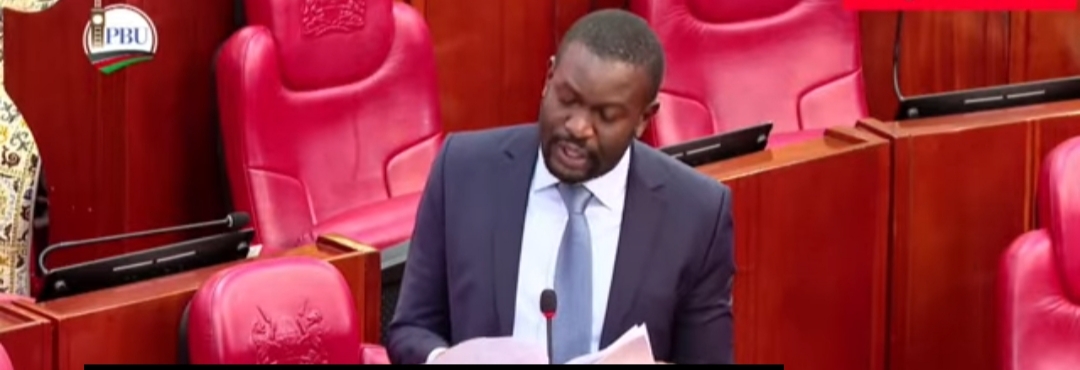
Nairobi Senator Edwin Watenya Sifuna speaking during the Senate session today
Nairobi Senator Edwin Sifuna threw his weight behind a public petition seeking a legal framework to recall the President and County Governors directly, delivering a scathing address in the Senate on Tuesday, July 14, 2026. Sifuna lauded Nakuru-based activist Laban Omusundi for his relentless public-interest litigation, comparing his determination to Busia Senator Okiya Omtatah.
"Mr. Speaker, I have had occasion to meet this gentleman called Labani... I think in the spectre of petitions to this house, he’s in the same league as Senator Oki Tata when it comes to litigating matters before our courts because Laban Musundi never gives up," Sifuna stated.
The petition, currently under Senate review, proposes that citizens be granted the constitutional right to recall a President or Governor mid-term. Sifuna challenged the House to reflect on why Kenyans are seeking direct intervention, pointing out that citizens feel neglected by their elected representatives.
"We should be asking ourselves as a house why are Kenyans feeling that those of us who've been given responsibility to oversight the executive are failing them so much that they want to do this thing themselves?" Sifuna asked.
Sifuna traced the root of this public frustration to Article 104 of the Constitution, which originally intended to give voters the power to recall non-performing lawmakers. He argued that the current desperation among the electorate stems from a deep sense of political betrayal, with leaders habitually breaking their pre-election promises.
"There is actually a history to Article 104... because there is a growing frustration with leaders in this country. You elect someone, they tell you 'this is what they are going to do', two months later they are doing the exact opposite," he noted.
The Nairobi Senator decried the rapid post-election shifts in political alignments, recalling how politicians abandoned their coalitions almost immediately after the 2022 general election. He specifically mentioned how members of the Azimio la Umoja coalition, including Mandera Senator Ali Roba, quickly crossed over to the government side before even electing the Senate Speaker.
"Immediately we were elected, it didn't even take a month. People who were with us in our political formation of Azimio, including my good friend from Mandera Senator Ali Robba—they ran away from us... barely a few days before we elected the Speaker of this House, people had already decided to jump ship," Sifuna said.
Sifuna accused previous parliaments of deliberately sabotaging the right of recall under Article 104 to protect themselves from voter accountability. He referenced a 2017 High Court case filed by the Katiba Institute, which struck down the legislative framework on recalling MPs after finding that lawmakers had intentionally made the process practically impossible to execute. Sifuna noted that Parliament
"went and put as many obstacles as possible to a simple right that had been given under the Constitution to make sure that of course it didn't work."
He pointed out the inherent conflict of interest in expecting legislators to draft laws that govern their own potential removal from office. Sifuna expressed doubt that the National Assembly would ever willingly pass a law that serves the public interest at the expense of their own job security.
"It is a source of frustration for Kenyans because you see we are essentially being asked as Parliament... to be judges in our own matter. I don't really think that the framers of the Constitution expected Parliament to ever pass a law that is detrimental to the interest of the members of Parliament," he added.
Citing the Senate Justice and Legal Affairs Committee (JLAC) report, Sifuna noted that the petitioner’s push is a direct response to a legislature compromised by external influence. He highlighted the petitioner's assertion that both parliament and county assemblies are frequently paralyzed by executive patronage, financial inducements, and party intimidation.
"This compromised oversight leaves citizens constitutionally stranded when the elected representatives fail to hold the executive accountable," Sifuna agreed.
Sifuna drew historical parallels, pointing out that the executive has historically used its legislative majority to shield itself from accountability, referencing the "tyranny of numbers" era. He noted that during former President Uhuru Kenyatta's tenure, ruling coalition members often viewed their primary role as protecting the President rather than serving as an independent oversight organ.
"They misunderstood their role to be the protection of their political leader, that there was no way you could bring an impeachment motion against President Uhuru Kenyatta because those were his people," Sifuna explained.
He further criticized the systematic collapse of impeachment efforts against high-profile executive officials due to backroom political deals. Sifuna recalled a controversial past impeachment attempt against then-Agriculture Cabinet Secretary Mithika Linturi, which abruptly ended after political maneuvering behind closed doors in Naivasha.
"I remember a famous case when there was an attempted motion of impeachment... and something happened in Naivasha there and that motion just died. Up to today, Honorable Linturi has never given us what really happened, the full story of why that impeachment motion could not even be tabled," he said.
Addressing current public clamor for the impeachment of President William Ruto under Article 145, Sifuna admitted that such parliamentary processes are practically impossible under the current political landscape. He explained that party loyalty and executive influence make it impossible to rally the required legislative numbers, even in the face of gross constitutional violations.
"It is impossible to convince the members of the National Assembly who are allied to the president, for instance, to support a motion of impeachment. Even in the face of the most gross violation of the constitution... they will still not support that impeachment motion," Sifuna stated.
Sifuna extended this critique to county governments, arguing that Members of County Assemblies (MCAs) are completely stripped of their oversight independence by party bosses. He recalled his time as the Secretary-General of the Orange Democratic Movement (ODM), when local representatives would seek party permission before drafting impeachment motions against governors.
"I see people who are elected as MCAs in this county who cannot even draft a motion of impeachment without reference to their political parties and political leaders. They used to come to my office when I was still the SG of ODM and say, 'SG, if we try this impeachment, will we be called?'" Sifuna recalled.
To illustrate the lengths to which county bosses go to evade accountability, Sifuna described incidents of physical violence and forced quorum-busting. He highlighted cases where county assemblies were physically burned down to destroy the Hansard, and other instances where governors allegedly sequestered MCAs at coastal resorts to prevent impeachment votes.
"We had a case where the assembly was burned down... the official Hansard was destroyed... There was another incident a few years back where a governor, fearing that MCAs would impeach him, sequestered a large number of them at a coastal destination... so that you can deny the house quorum," Sifuna revealed.
Concluding his remarks, Sifuna warned his colleagues that ignoring the will of the public has dangerous consequences, citing the historic June 25, 2024, storming of Parliament. He asserted that the youth-led protests against the 2024 Finance Bill proved that if lawmakers refuse to act as the voice of the people, the public will eventually bypass them to speak for themselves.
"The people tell you in no uncertain terms that they do not want you to vote for imposition of more taxes on them, and then you have members of Parliament running around saying they will not change even a comma... It took those young people storming Parliament for us to be able to get their voices heard. June 25th, 2024, showed that you can be gotten too if you refuse to listen to the people," Sifuna concluded.
Tags: Babu Owino Edit Editor's Pick Editors choice Edwin Watenya Sifuna Linda Mwananchi Nairobi Odm ODM Odm Zoning Samsom Cherargei Senate Senate Commitee Sifuna Signs Signs Media Signs Media Kenya Limited Signs Tv Signsmedia Signst Signstv Signstvkenya Signsv The senate The senate committee The senate debates

Share this article

FELIX MAKONA
FACT FINDER AND DATA DRIVEN JOURNALIST. DATA MINING AT IT'S BEST. GET FACTS RANGING FROM MATTERS DISABILITY AND INCLUSION, POLITICS, ECONOMY, SPORTS AND GENERAL NEWS AROUND THE WORLD