

Ruto Cries In Wajir As He Pledges A New Era Of Inclusion, Dignity And Equal Opportunity
News Updated: 01 June 2026 12:46 EAT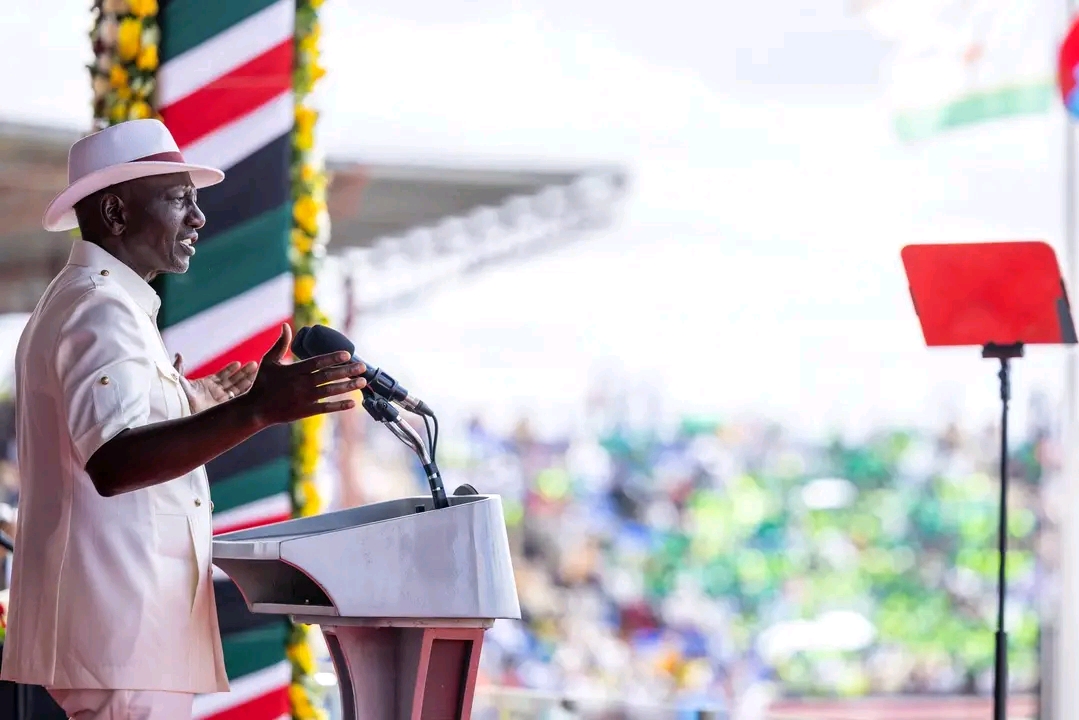
President William Samoei Ruto addressing citizens if Wajir County at Wajir Stadium during 63rd Madaraka celebrations
President William Ruto delivered a landmark address during the 63rd Madaraka Day celebrations in Wajir County, using the occasion to reaffirm his administration's commitment to ending historical marginalisation in northern Kenya. Speaking before thousands of residents and national leaders at Wajir Stadium, the President described the hosting of Madaraka Day in the county as a defining moment in Kenya's history and a powerful statement that every citizen and every region matters equally within the republic.
“This is Wajir County and this is Kenya. This is what we meant when we said we would leave no one behind: the great people of Wajir County. Distinguished leaders, ladies and gentlemen, today we make history. For the first time in 63 years of self-rule and national celebration, Madaraka Day is being hosted here in Wajir in the heart of northern Kenya. This is not a mere ceremonial gesture. It is a national declaration. It is a moment of affirmation that Madaraka, our freedom, our dignity, our self-determination was never meant for some Kenyans and not for others. It was never meant for some regions and withheld from others. Madaraka belonged, still belongs, and will forever belong equally to every single Kenyan.”
The Head of State reflected on Kenya's independence journey, arguing that self-rule was intended to create equal opportunities for all citizens regardless of geography. He said the celebration in Wajir symbolised the country's determination to fulfil the promises made at independence and ensure no community remains excluded from national development.
“Fellow citizens, on Madaraka Day in 1963, our freedom fighters did something consequential. They secured the transfer of political authority from colonial hands into African hands and into Kenyan hands. But self-rule was never simply about changing who holds power. It was about beginning the long but necessary journey of building a nation worthy of the sacrifices that secured its freedom. That promise, that work in progress, is the reason we are here today in Wajir. Decades after independence, this region was left behind through neglect, marginalization, discrimination, and policy failures. Sessional Paper Number 10 of 1965 entrenched a development paradigm that concentrated development in the so-called high-potential areas.”
In one of the most emotional moments of the ceremony, President Ruto formally apologised to the people of northern Kenya for decades of exclusion, saying the nation had failed many communities that deserved equal treatment and opportunity.
“Fellow citizens, I want to tell you that on behalf of the people of Kenya, today as I stand here as President and leader of our great nation, to the people of Kenya in northern Kenya, for this marginalization, I want to apologize on behalf of the nation of Kenya, for it was never meant to be this way. I want to tell you the story of Bakaja Ibrahim Osman. He was born here in Wajir East of this county in the early 1960s. His parents were born here. But for years, every time Osman went to apply for an identity card, the most basic document of citizenship, he was treated not as a Kenyan but as a suspect, an illegal alien.”
The President defended reforms introduced in 2025 that ended additional vetting requirements for identity card applicants in northern Kenya, saying the changes restored dignity while maintaining national security safeguards.
“The Constitution of Kenya says clearly every Kenyan, regardless of their ethnicity, religion, or geography, deserves equal protection, equal dignity, and equal treatment under the law. That is why in February 2025, right here at Ora grounds in Wajir town, I signed the presidential declaration on registration and issuance of IDs and birth certificates in northern Kenya and other counties ending that system of discrimination. The results, ladies and gentlemen, are already being felt. Citizens like Abra Abdul Rahman Ali Osman and Mariam Isak Muhammad, both born in 2007 here in Wajir County, were among thousands of young Kenyans who turned 18 last year and walked away with their national identity cards.”
Education featured prominently in the President's speech as he described learning as the foundation upon which Kenya's future prosperity will be built. He said the country's next phase of liberation would be achieved through knowledge, innovation and skills development.
“Of all the investments, ladies and gentlemen, we are making in Northern Kenya, none is more important than education, which is also the theme of this year's Madaraka: education, skills, and the future. Of all the tools a nation possesses, education is the most potent. It is the bridge between promise and possibility, between poverty and prosperity and between exclusion and belonging. Unlike in 1963, the next frontier of Kenya's liberation will not be fought on conventional battlefields. It will be won in classrooms and lecture halls, laboratories and workshops, and in innovation hubs.”
Ruto said the Competency-Based Education system and increased investment in the education sector were preparing Kenyan learners to compete globally and contribute to industrial transformation.
“The Competency-Based Education and Training system is transforming what learning means in Kenya. It is equipping our children not merely to pass examinations but to think critically, solve problems, innovate, and compete on the global stage. What particularly encourages me is that 52% of learners in the first-ever Grade 10 cohort have chosen the STEM pathway. This tells us that a new generation is rising. One that will drive Kenya's industrial transformation, power our technological advancement, and build the innovation economy that will define our nation's next chapter.”
The President announced major interventions aimed at solving teacher shortages in northern Kenya, including the operationalisation of teacher training colleges and affirmative recruitment programmes for local educators.
“That is why this administration has made education not just a priority but the foundation of our future. Our education budget has grown from 500 billion in 2022 to over 702 billion today. We have hired more than 100,000 teachers in just three years with 20,000 more set to be hired this year. Today, through this affirmative action program, a record 1,800 local teachers from the three counties of Wajir, Mandera, and Garissa have been employed and will be deployed in the region. Additionally, 4,616 young people from this region are enrolled in teacher training colleges, the highest number in our history.”
The Head of State also directed the Ministry of Education to begin consultations aimed at formally integrating madrasa education and pastoral learning programmes into the national education framework.
“Yet, some children in northern Kenya and other marginalized regions remain outside the formal education system because of certain alternative learning pathways that have not been adequately recognized or accommodated within our education framework. Today, I direct the Cabinet Secretary for Education to engage all relevant stakeholders and take the necessary measures under the Basic Education Act to consult widely and recommend appropriate measures for the formal integration of the same. This will ensure that every child regardless of background or circumstance has a recognized pathway into learning skills and opportunity.”
On healthcare, Ruto highlighted the expansion of the Social Health Authority and the impact it has had on access to medical services across northern Kenya.
“Inclusion must also mean access to quality healthcare, dignity, and well-being for every citizen. Today of the 31.5 million Kenyans registered with the Social Health Authority, about 800,000 are residents of Wajir, Garissa, and Mandera counties. To date, SHA has paid 8.1 billion Kenya shillings in claims for services provided in these three counties, demonstrating the transformative impact of this reform on access to quality healthcare.”
The President further outlined youth empowerment initiatives, digital skills programmes and affordable housing projects that are being implemented across the region to stimulate economic growth and create employment opportunities.
“Already more than 2,500 youth across all wards of Wajir County have benefited from the Nawiri program through business support, capital, training, and mentorship. We are also investing in digital hubs, ICT centers, digital skills programs, and digital infrastructure so that a young person in Wajir can compete with any person in Kenya and globally. Today in Wajir County through our affordable housing program, we have invested 15.6 billion shillings in the development of 4,600 housing units. This is the largest housing development Wajir has witnessed since independence.”
Infrastructure development formed another key pillar of the address, with the President describing the Northern Kenya Gateway Corridor as a transformative project that will connect communities to opportunities and markets.
“That is why connectivity remains central to northern Kenya's transformation. For decades, distance was used to justify exclusion. Today we are defeating distance with a 750-kilometer northern Kenya gateway corridor linking Isiolo, Wajir, and Mandera. We are undertaking the most significant and consequential road investment in this region since independence. This investment, this single road, is going to cost the government of Kenya close to 100 billion Kenya shillings. This is more than a road project. It is a bridge between exclusion and opportunity.”
Ruto devoted a significant portion of his speech to livestock development, describing pastoralism as a cornerstone of the regional economy and outlining measures aimed at transforming the sector into a major export industry.
“And then there is livestock. Here in Wajir and across northern Kenya, livestock is more than an economic activity. It pays school fees, feeds families, creates jobs, drives trade, and in difficult times sustains entire communities. We have distributed more than 52,000 sheep, goats, and cattle to over 10,000 households across 16 arid and semi-arid lands. We have vaccinated more than 10 million animals, expanded local vaccine production to over 123 million doses, established feedlots and hay storage facilities, restored more than 3 million hectares of degraded rangelands, and strengthened livestock marketing infrastructure.”
The President announced plans for a Sh5 billion livestock investment initiative that will enable pastoralists to own enterprises linked to livestock production, value addition and exports.
“That is why we are establishing a Kenya shillings 5 billion county livestock investment company initiative to support more than 350,000 pastoralists across 21 ASAL counties to form and own livestock investment companies. Through these enterprises, they will gain access to markets, finance and insurance, and value add their produce. We must move beyond live animal exports to higher-value products such as meat, leather, and dairy. We look at livestock and see enterprise. We see exports. We see jobs. We see wealth.”
Looking ahead, Ruto said water infrastructure and irrigation projects would play a central role in unlocking northern Kenya's economic potential and enhancing national food security.
“Water means irrigation. Water means food production, industry, resilience, and opportunity. That is why my administration has set the ambition to build 50 mega dams across the country, 200 medium and small dams, and thousands of micro dams. These dams, many in northern Kenya, are among the many projects in our priority list. Each of these dams is a statement that no county is too remote to deserve investment and no river too far to be harnessed for the good of Kenya.”
In his closing remarks, the President declared that northern Kenya was no longer on the periphery of national development and pledged continued investment in the region.
“For decades, some parts of our country were told they were too distant, too dry, too difficult, or too marginal to matter. Today from Wajir, Kenya rejects that thinking. We affirm that no community is peripheral to our national story. No child is too far away to deserve opportunity. No citizen is too distant to deserve dignity. From Busia to Mandera, from Turkana to Kwale, and from Kisumu to Mombasa, every corner of this great republic matters because every Kenyan matters. Wajir is not the edge of Kenya. Wajir is Kenya. Northeast is Kenya and Kenya belongs to all of us. From now going forward, we are going to walk together shoulder to shoulder as one people, one nation with a common destiny.”
Tags: Article Edit Editor's Pick Editors choice KBB KBB Kumi Bila Break Madaraka Day Madaraka Day. News Article President William Ruto Rachel Ruto Ruto Signs Signs Media Kenya Limited Signs Tv Signsmedia Signstv Signstvkenya William Ruto William Samoei Ruto Williiam Ruto
Share this article
FELIX MAKONA
FACT FINDER AND DATA DRIVEN JOURNALIST. DATA MINING AT IT'S BEST. GET FACTS RANGING FROM MATTERS DISABILITY AND INCLUSION, POLITICS, ECONOMY, SPORTS AND GENERAL NEWS AROUND THE WORLD