
Ruto at G7: Africa Pushes for Equal Seat in New Global Order
News Updated: 16 June 2026 17:02 EAT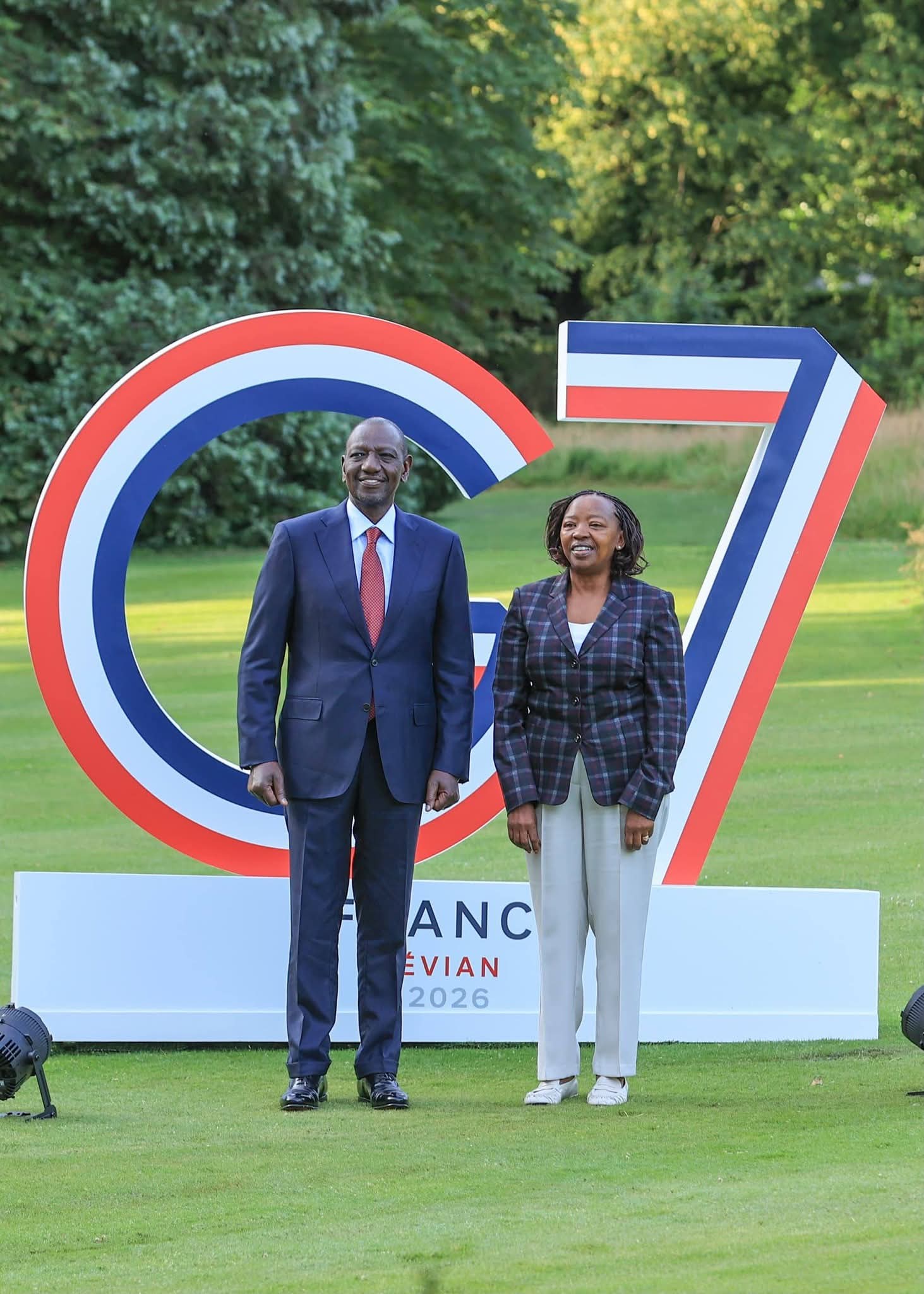
President William Samoei Ruto and First Lady Mama Rachel Ruto when they arrive for the G7 conference in France
President William Ruto used Kenya’s participation at the G7 engagement in France to outline a far-reaching call for a restructured global order that places Africa at the centre of economic, financial, and technological decision-making.
He framed Africa’s future engagement with global partners as a shift away from dependency-based relations toward sovereign equality and mutually beneficial partnerships, arguing that the continent’s resources and markets should be integrated into global growth on fair terms.
“We are presenting a new paradigm shift of relationship between Africa and our partners. This is no longer going to be a relationship about dependency. It's going to be a relationship about sovereign equality. It is not going to be a relationship about aid, charity, assistance. It is going to be a relationship that we want about mutually beneficial partnerships. And number three, our proposal is that extraction is no longer acceptable or tenable. Going forward, we believe that the most consequential and beneficial relationship is through investments that are mutually beneficial, so that African assets, natural resources, vast renewable energy resources, arable lands, and human capital including market should be useful not just for us as Africans but mutually beneficial for those who are going to invest with us. So we are clear on what we have, what we have come to achieve, and what Africa's position is going to be.”
Ruto also argued that the current global order is undergoing deep structural change, insisting that Africa must now be fully integrated into the redesign of international institutions such as the United Nations, the IMF, and the World Bank.
“Secondly, we will be in the new global order. We believe that a new San Francisco moment is imminent. The world order as we have known it is faltering. It is not that it's going to happen; it's already happened. We also believe that international institutions including the United Nations are a necessary imperative. World Bank, IMF, other institutions have a serious role to play. But we need a new relationship. We need a new engagement. Africa was not present when these institutions were reconfigured. Then this time round, Africa must be at the center of it. We cannot continue to have an international governance order, for example, that is not democratic, that is not representative, and that is not accountable.”
He further stressed that reform of global governance structures is not a matter of accommodation but of legitimacy, calling for a more democratic and accountable United Nations system.
“Our position is that whether it is seats at the UN Security Council, use of the veto which is very controversial, and also accountability—because the United Nations as we see it in the new order must be run not by an administrator but as by a reformer. And number two, it must be a UN that is representative, that is democratic, and that is accountable. And this is not about accommodating Africa. No, it goes to the heart of the legitimacy of the UN, of the credibility of the UN, and actually the existence of the UN as we know it.”
The President linked current geopolitical tensions to what he described as a collapsing global framework, citing ongoing conflicts as evidence that existing systems are no longer sufficient to manage modern crises.
“There is a realization that the international architecture—the UN as we have known it—is no longer fit for purpose. This has been our position and therefore there is a reality that people are living with. Many people thought, for example, that you can solve global conflicts in days or weeks. We have seen what is happening in Ukraine. We have seen what is happening in Iran. So there's a new reality that we all must face: that a new world order is necessary that deploys new tools for engagement.”
He highlighted prior African-led engagements as building blocks toward a unified continental position, referencing climate and economic forums held in Nairobi and other platforms aimed at strengthening Africa’s negotiating power.
“It is a buildup from where we were in 2023. First, we convened the Africa Climate Summit in Nairobi that brought together African heads of state and stakeholders to discuss and consolidate our position, ideas, and suggestions on how climate change and the effects of it were affecting not just us; and Africa did not need to continue just being a victim, but a significant contributor to how a solution could be found. It is also against the background of the Africa Forward Summit that we held last month where 33 heads of state were in attendance with our friends from France, and again we built consensus on where is Africa going, how is it going to play in the global scheme of things.”
Ruto outlined the structure of Kenya’s engagement at the summit, noting that discussions would focus on partnerships, development, and technology governance, including artificial intelligence.
“We come here with very clear ideas. Number one, there will be three sessions. Session number one will be about forging new partnerships, international solidarity that is going to inform the new world order. We are also going to be discussing development. We are going to be discussing how we are going to forge a new development paradigm of shared economic activity and shared growth that is global, and who is going to play what. And finally, we're going to be discussing about technology—how e-government, AI technology governance, how is everybody going to play?”
He positioned Africa as a central actor in the global future, particularly in energy transition, food systems, and demographic growth, while rejecting narratives that portray the continent as a burden.
“Africa is not a problem to be solved. Africa is an asset. Africa is an opportunity. Africa is not anybody's liability. Africa can actually significantly and will significantly contribute to global prosperity. Why? Number one, we have huge natural resources that can be used including critical minerals that are necessary for energy transition. We have vast resources of renewable energy from wind, solar, geothermal, hydro that again are important for the world's prosperity. And number three, it is not possible going forward to discuss world food security without the vast untapped arable lands of the African continent.”
He added that Africa’s demographic expansion will make it a major global workforce and consumer market within decades, strengthening its strategic importance.
“40% of the world's workforce by 2050 will be will live in Africa. 25% of the world's population will live in Africa. Africa is not only going to be a workforce, it is also going to be a market. And therefore, going into the future, we must sort out three significant things.”
On financing, he called for reforms to global credit systems and interest structures, arguing that Africa continues to face disproportionately high borrowing costs and risk ratings.
“We must sort out number two: that Africa continues to borrow from the international community at significantly high interest rates, even higher than comparable economies everywhere in the world. And number three, we must deal with a mispriced Africa—one that is that global credit rating agencies exaggerate the risk of Africa and by so doing undermine the opportunities and the prospects of the African continent.”
He also pointed to Africa’s untapped domestic capital pools, including pension funds and reserves, as key sources for development financing if properly mobilised.
“We are also very clear that Africa does not lack capital. We have $4 trillion, for example, in domestic resources in pension funds, in insurance resources, in central bank reserves. What is lacking is the mechanism to mobilize these resources. We will be promoting to partners here how those resources can be mobilized to drive African growth and we will be asking for a win-win outcome.”
Ruto concluded by reiterating Africa’s demand for equal treatment in global systems, insisting that the continent must play a central role in shaping energy transition, food security, labour mobility, and emerging technologies such as artificial intelligence.
“We are not asking for Africa to be treated in a special way. We are asking for Africa to be treated equally. It's not a special treatment we are asking for. It is to be treated equally. And I don't think that's too much to ask. And finally, that we will agree on how technology—this time around artificial intelligence—Africa is not going to be merely a consumer, that Africa is going to write the rules and is going to be on the table on how artificial intelligence drives the next industrial and global revolution.”
Tags: Article Edit Editor's Pick Editors choice G7 Leaders News Article President William Ruto Signs Signs Media Signs Media Kenya Limited Signs Tv Signsmedia Signst Signstv Signstvkenya Signsv William Ruto William Samoei Ruto Williiam Ruto G7 Conference Government Of Kenya KBB KBB Kumi Bila Break Ruto Ruto Quotes
Share this article
FELIX MAKONA
FACT FINDER AND DATA DRIVEN JOURNALIST. DATA MINING AT IT'S BEST. GET FACTS RANGING FROM MATTERS DISABILITY AND INCLUSION, POLITICS, ECONOMY, SPORTS AND GENERAL NEWS AROUND THE WORLD