

Ruto Announces Fresh Fuel Relief As Matatu Operators Suspend Strike
News Updated: 22 May 2026 13:49 EAT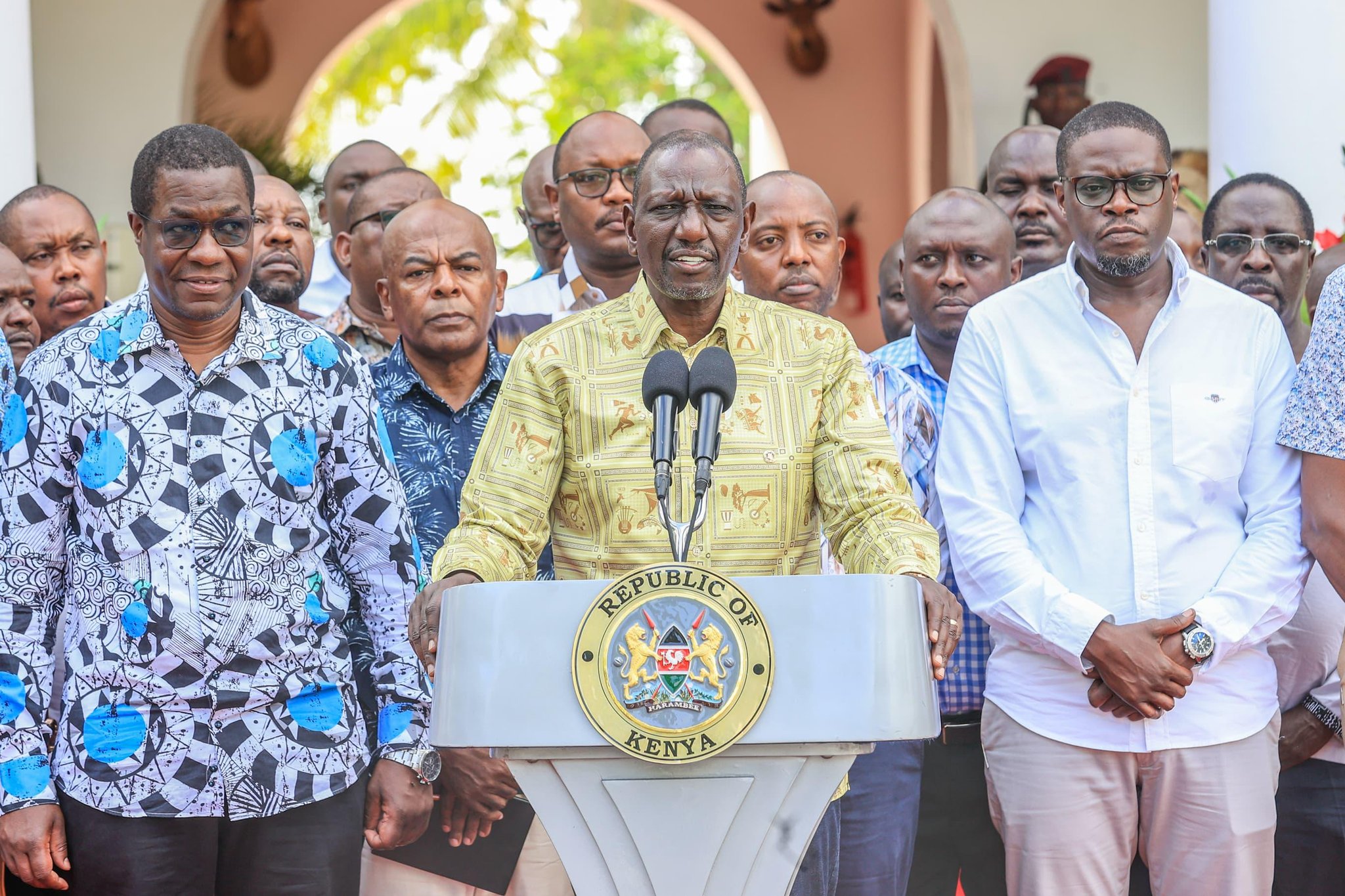
President William Samoei Ruto today speaking at a press conference where he announced KSh10 reduction for diesel in the June-July pricing cycle.
President William Samoei Ruto has successfully convinced matatu operators to call off the nationwide strike after announcing a further Ksh10 reduction in diesel prices during the next fuel pricing cycle. The announcement followed extensive consultations between the government and leaders from the transport sector held in Mombasa.
“This is not a crisis affecting Kenya alone. Countries across Africa, Europe, Asia, and the Americas are all struggling with rising fuel prices, fuel shortages, and disruptions in supply,” Ruto said.
The President linked the crisis to the escalating conflict involving Iran and disruptions at the Strait of Hormuz, one of the world’s most critical oil supply routes through which nearly 20 per cent of global oil passes every day.
“Since the conflict involving Iran escalated on the 28th of February 2026, the Strait of Hormuz has experienced major disruption. This has created one of the largest global oil supply shocks in modern history,” he stated.
According to Ruto, global fuel prices have risen sharply within weeks, with super petrol increasing by 54 per cent, diesel by 118 per cent and kerosene by 126.4 per cent internationally. He noted that the crisis was now affecting economies worldwide.
“The World Bank now projects that global energy prices will rise by 24 per cent in 2026 alone while the International Energy Agency has warned that global markets may remain under-supplied until late 2026 or beyond,” the President said.
Ruto maintained that Kenya could not escape the impact because the country imports all its fuel from the Gulf region. He acknowledged that the rising fuel prices had hit transport, agriculture, businesses and households hard.
“I know that for many Kenyans rising fuel prices are not just numbers at the pump. They reflect everyday life. They mean higher matatu fares, a farmer paying more for transport of produce, a boda boda rider worried about daily earnings, and a parent struggling to stretch the family budget,” he said.
The Head of State defended the government’s response, saying the administration had moved quickly to cushion consumers using the Petroleum Development Levy Fund and other interventions.
“The government of Kenya has not stood by. Through forward planning using the Petroleum Development Levy Fund, we have built strategic financial reserves to help stabilize the market during times such as this,” Ruto said.
He disclosed that in the April-May and May-June 2026 pricing cycles alone, the government spent Ksh13.7 billion on direct fuel stabilization measures.
“To cushion consumers from the sharp rise in global oil prices, the government has utilized Ksh13.7 billion in the last two pricing cycles alone,” he explained.
Ruto further announced that the government had reduced VAT on petroleum products from 16 per cent to 8 per cent to ease pressure on Kenyans and businesses.
“Working together with Parliament, we reduced VAT on petroleum products from 16 per cent to 8 per cent, foregoing Ksh14.4 billion in tax revenue in order to reduce pressure on Kenyan families and businesses,” he said.
According to the President, the April-May cycle alone consumed Ksh12.45 billion in stabilization and tax relief interventions, helping lower pump prices significantly.
“Because of this intervention, super petrol prices were reduced by Ksh19.67 per litre, diesel by Ksh40.25 per litre and kerosene by Ksh115 per litre,” Ruto stated.
He added that during the May-June pricing cycle, the government spent another Ksh15.72 billion on stabilization efforts.
“As a result, super petrol prices were reduced by Ksh15.87 per litre, diesel by Ksh44.89 per litre and kerosene by Ksh78 per litre,” he added.
The President argued that without government intervention, fuel prices would have risen to record highs across the country.
“Without government intervention during this cycle, super petrol would today have retailed at Ksh230 per litre instead of Ksh214. Diesel would be retailing at Ksh277.75 instead of the current Ksh232.86,” Ruto said.
Taken together, the government has now spent Ksh28.19 billion on fuel support measures across the two pricing cycles.
“These interventions have protected millions of Kenyans from even more severe economic hardship,” he emphasized.
Ruto announced that diesel prices would now be reduced further by Ksh10 in the June-July cycle following consultations with transport operators.
“I have directed that in the next pricing cycle we are going to further reduce the price of diesel by another Ksh10 to help stabilize pump prices and provide additional relief to consumers,” the President declared.
The Head of State also defended the government-to-government fuel import framework introduced in 2023, saying it had protected Kenya from severe shortages and dollar pressure.
“Through the government-to-government fuel supply framework, we have secured guaranteed fuel supplies despite global supply chain disruptions,” he said.
Ruto insisted that without the arrangement, Kenya would have faced both a fuel shortage and a foreign exchange crisis.
“Without a guaranteed supply framework, there would be a major crisis of foreign currency and there would be a major crisis of supply,” he warned.
The President accused some politicians of exploiting the fuel crisis for political gain instead of supporting national efforts to stabilize the economy.
“I know there are those trying to turn this global crisis into politics. Leadership requires honesty, not political opportunism or playing populist politics,” he said.
Ruto defended the continued collection of fuel taxes and levies, saying removing them entirely would cripple key public services and development programmes.
“If we stop collecting these revenues entirely, what public services shall we stop funding? Do we stop road projects, fertilizer subsidies, hospitals, schools and security operations?” he posed.
The President said leadership required difficult but responsible decisions aimed at protecting both current and future economic stability.
“Our responsibility as government is to solve today’s problem without creating a bigger problem tomorrow,” he stated.
Ruto further revealed that Kenya was now working with East African partner states to develop regional oil reserves and establish a refinery to reduce dependence on imports.
“The government of Kenya together with our East African partners is determined to bring into production our oil reserves in Turkana and develop a regional refinery,” he said.
He disclosed that the government was also accelerating investments in renewable energy and electric mobility to reduce future vulnerability to global oil shocks.
“We must embrace electric vehicles as a first step,” the President stated.
Ruto announced that the government had already ordered 3,000 electric vehicles for security and administration officials.
“I am also making a declaration that the first 100,000 electric vehicles imported into Kenya, whether for public service or private use, will be duty-free,” he announced.
The President assured Kenyans there was no fuel shortage in the country despite the global crisis.
“I wish to assure the country that there is no fuel shortage in Kenya. The government is taking all necessary measures to ensure uninterrupted supply and stability in the market,” he said.
Ruto urged Kenyans to remain calm and united during the difficult economic period facing the country.
“This situation is not permanent. We have overcome droughts, floods, terrorism and COVID-19 before because we stood together as one people,” he stated.
Addressing transport operators directly, the President said the government understood their frustrations and would continue engaging them on practical solutions.
“To our transport operators, drivers and logistics workers, we hear your concerns. We respect the important role that you play in keeping our economy moving,” he said.
Ruto further announced that the Ministry of Transport would engage banks to seek temporary relief for transport operators servicing vehicle loans.
“The Ministry of Transport will engage financial institutions to address financial challenges arising from the current crisis, including temporary relief on lending terms,” he announced.
The President also directed the Insurance Regulatory Authority to address complaints involving insurance claims affecting matatu operators.
“There is a big issue where transport operators despite having insurance covers end up paying bills when accidents occur while insurance companies go scot-free,” he said.
Ruto added that the government would review both the Insurance Act and the Auctioneers Act within three months to create a fairer framework for the sector.
“I have directed that an immediate review of both the Insurance Act and the Auctioneers Act be undertaken within the next three months,” he stated.
The President also ordered the National Transport and Safety Authority to streamline the digital taxi sector by implementing minimum fare regulations.
“The Ministry of Transport through NTSA will engage digital taxi operators with a view to implementing regulations on minimum taxi fares,” he announced.
Ruto further defended matatu culture and directed NTSA to allow operators to continue using graffiti and artwork on their vehicles.
“The industry is telling me they have been told to remove graffiti from their matatus and I am asking myself why,” the President remarked.
The Head of State urged Kenyans to reject violence, misinformation and destruction during protests over the fuel crisis.
“While every citizen has a right to express concerns, collectively we must reject hooliganism and all forms of violence that lead to loss of lives and destruction of property,” he said.
Ruto concluded by assuring Kenyans that the government would continue engaging stakeholders and pursuing diplomatic efforts to ease the international crisis affecting fuel supply.
“We must confront this challenge in the same spirit of unity, resilience and national resolve that has carried Kenya through difficult moments before,” he said.
Tags: Edit Editor's Pick Editors choice Epra EPRA Epra New Fuel Prices EPRA Matatu Matatu Operators News Article President Ruto President William Ruto Signs Signs Media Kenya Limited Signsmedia Signstv Signstvkenya Tutam Two Term William Ruto William Samoei Ruto

Share this article

FELIX MAKONA
FACT FINDER AND DATA DRIVEN JOURNALIST. DATA MINING AT IT'S BEST. GET FACTS RANGING FROM MATTERS DISABILITY AND INCLUSION, POLITICS, ECONOMY, SPORTS AND GENERAL NEWS AROUND THE WORLD