

Oburu Oginga Backs Ruto Development Agenda And Domestic Borrowing Strategy In Kajiado Church Service
News Updated: 14 June 2026 19:04 EAT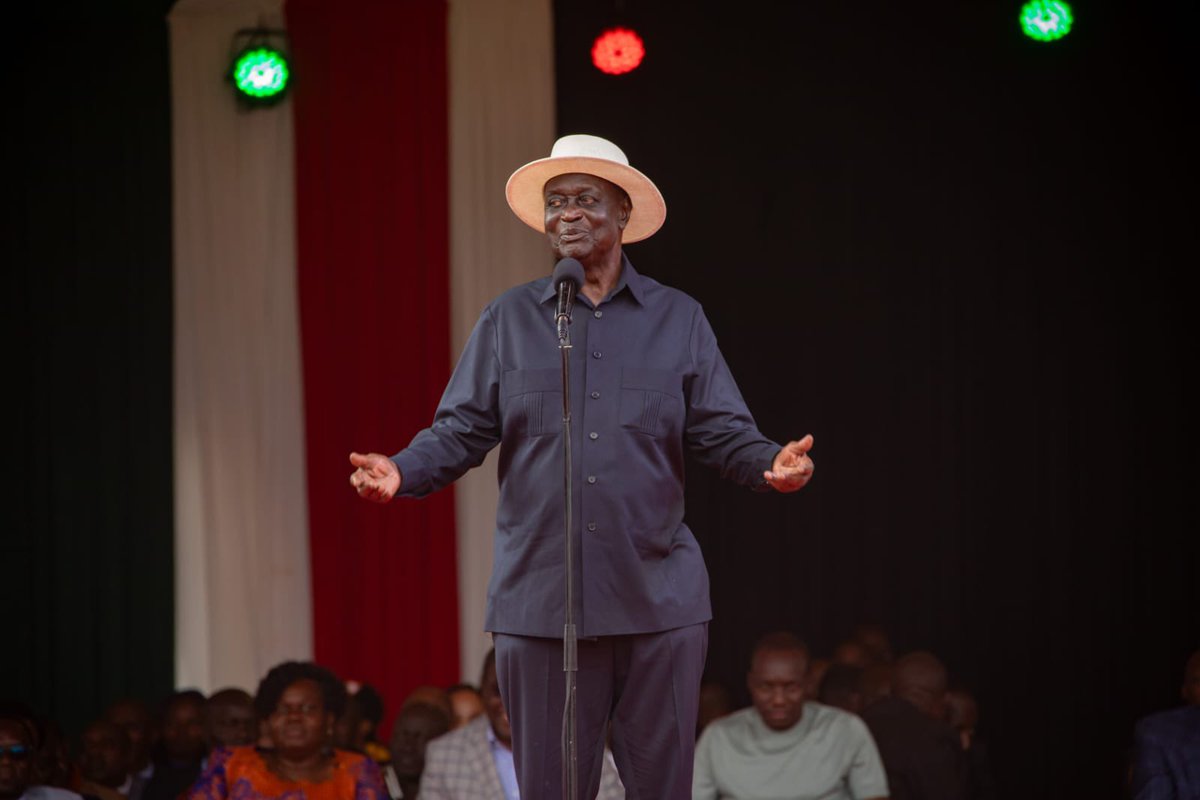
Orange Democratic Movement Leader Dr Oburu Oginga speaking at the ch
President William Ruto attended a church service in Kajiado County where leaders used the platform to reflect on national unity, governance, development progress and economic strategy, with former Cabinet Minister Oburu Oginga offering strong political and policy support during the gathering.
During the service, Oburu framed Kajiado as a symbol of national cohesion due to its ethnic diversity, arguing that inclusive leadership is essential for stability. He stressed that leaders who promote division would not succeed in such a setting, reinforcing the importance of unity in national politics.
“His Excellency, the President of the Republic of Kenya, William Samoei Ruto, and all protocols observed, now Kanisa and the Holy Church of SDA, and all the believers who have come and the leadership of the church. I want to say, I came here this morning to pray. I also came to give something because the priest told me that giving to God is not sinful, and therefore I’m not going to sin. I’m just going to give to God and I’m going to give as much as I can or as little as I can. And Your Excellency, this county is a county which is mixed with almost all tribes of Kenya living in Kajiado, and therefore this is a county where if you are discriminative, if you want to divide people, you cannot survive here in Kajiado. You can only survive if you are a nationalist. If you are a person with vision, if you are a person who wants to unite the country.”
He further used the occasion to emphasize that national cohesion should remain a guiding principle for leadership across the country, noting that diverse counties require inclusive politics that prioritise unity over ethnic or partisan division.
Oburu also defended the President’s frequent nationwide engagements, dismissing criticism that they amount to political campaigning. He instead described them as active leadership and oversight of development projects across the country.
“I know we have people who are saying that you are doing nothing. But I wonder whether they live in this country. I have lived in this country for more than 80 years and Your Excellency, I can tell you that the type of energy you have moving all over the country, jumping up and down, I have never seen any president doing that since I was born. I’ve never seen this kind of work which you do to the people; it is only done during campaigns. Some people might say that you are campaigning throughout, but campaigning throughout is, I mean, God-given. If it is campaigning, me, I don’t believe you are campaigning. What I believe you are doing, you are inspecting development projects, and I see even when you come to pray like this, the leaders who come before you here are pleading with you to do some things which have not been done because development can never end. It will go on and on and on, and nobody will develop this country and say, 'I have now finished development.' If America is still developing, how can Kenya ever reach there? We have not reached even a quarter of them. But we want to reach there very soon. We want to go to that first world very, very soon. And I can see the measures which are being taken by Kenya are going to take us there.”
He added that development is a continuous process, arguing that no country ever reaches a point of completion, and expressing optimism that Kenya’s current trajectory could accelerate its economic transformation if sustained.
On economic policy, Oburu strongly supported the government’s push toward domestic borrowing, saying it reduces reliance on external lenders and strengthens internal financial systems. He argued that foreign borrowing often comes with high costs and structural disadvantages.
“People are complaining that there is a very big gap in the financing of the country. But this, I'm a finance expert and I can tell you that the financing of this country, the levels where the country is borrowing, we are borrowing from our own. We are not going to beg in the international market with a heart in every capital begging. We want to trade with them. We don’t want to be beggars. And what you say is borrowing from within is actually what should be done. What do those other countries do? Those countries owe you that you think they can be giving you money for nothing? They exploit you. When you take money from them, they charge you a lot, and it is in their interest. So we must use our own resources and you have started to do it. You have created an infrastructure fund which is an internal matter. You are developing, we have a housing levy. People are complaining but we can see the results of the collections. The results are imminent and they are evident. So you are raising money from within to develop our own country. This is important, and when you have a gap in the revenue you collect and the development projects and the current expenditure you want to do, this is not anything which is new. All countries do it. All countries have a deficit. It is not only our country which has a deficit. All countries have a deficit, but it is only how you finance the deficit that is important.”
He pointed to domestic financing mechanisms such as infrastructure funds and housing-related levies as evidence of a shift toward internal resource mobilisation, saying these tools are central to closing development funding gaps.
Oburu concluded his remarks by signalling political alignment within the region while still framing the gathering as a national event, noting the presence of leaders across party lines and strong local political influence.
“And I want to tell Your Excellency that this occasion where you have come for is a noble occasion, and I'm the one who was used by God to come to bring Joshua Cawino Yeshua to you to plead with you to come and do this occasion, to do what God has planned. So, I know amongst you here, I don’t want to ask you to raise your hand, but I’m sure a lot of you are also ODM. A very good number of you are ODM because here we have three MPs who are ODM and two are other parties, and the governor is ODM, the deputy governor is ODM. So Your Excellency, this is an area where you, you, you, we are going to talk. If this is not my zone or if it is somewhere where we can share something, but this is strongly an ODM zone. And Your Excellency, I don’t want to say much more because that is something which will be discussed somewhere else. I want to thank the clergy for inviting us for this solution. I know SDA—I didn’t know that SDA also play on Sundays. However, you can pray anywhere and any day, and God will listen to you. So God is listening to you and to all of us. Thank you very much.”
The service ended with remarks emphasizing faith, unity and continued cooperation between political leaders and religious institutions in supporting national development goals.
Tags: Article Editor's Pick Editors choice Factual data Felix Makona Get facts News Article Oburu Oburu Odinga Oburu Oginga Political Parties Political Partys Political Science Political tensions Politics President William Ruto Signs Signs Media Kenya Limited Signsmedia Signstv Signstvkenya William Ruto William Samoei Ruto
Share this article
FELIX MAKONA
FACT FINDER AND DATA DRIVEN JOURNALIST. DATA MINING AT IT'S BEST. GET FACTS RANGING FROM MATTERS DISABILITY AND INCLUSION, POLITICS, ECONOMY, SPORTS AND GENERAL NEWS AROUND THE WORLD