

Chief Justice Urges IEBC To Enforce Electoral Laws Ahead Of 2027 Polls
News Updated: 24 June 2026 16:14 EAT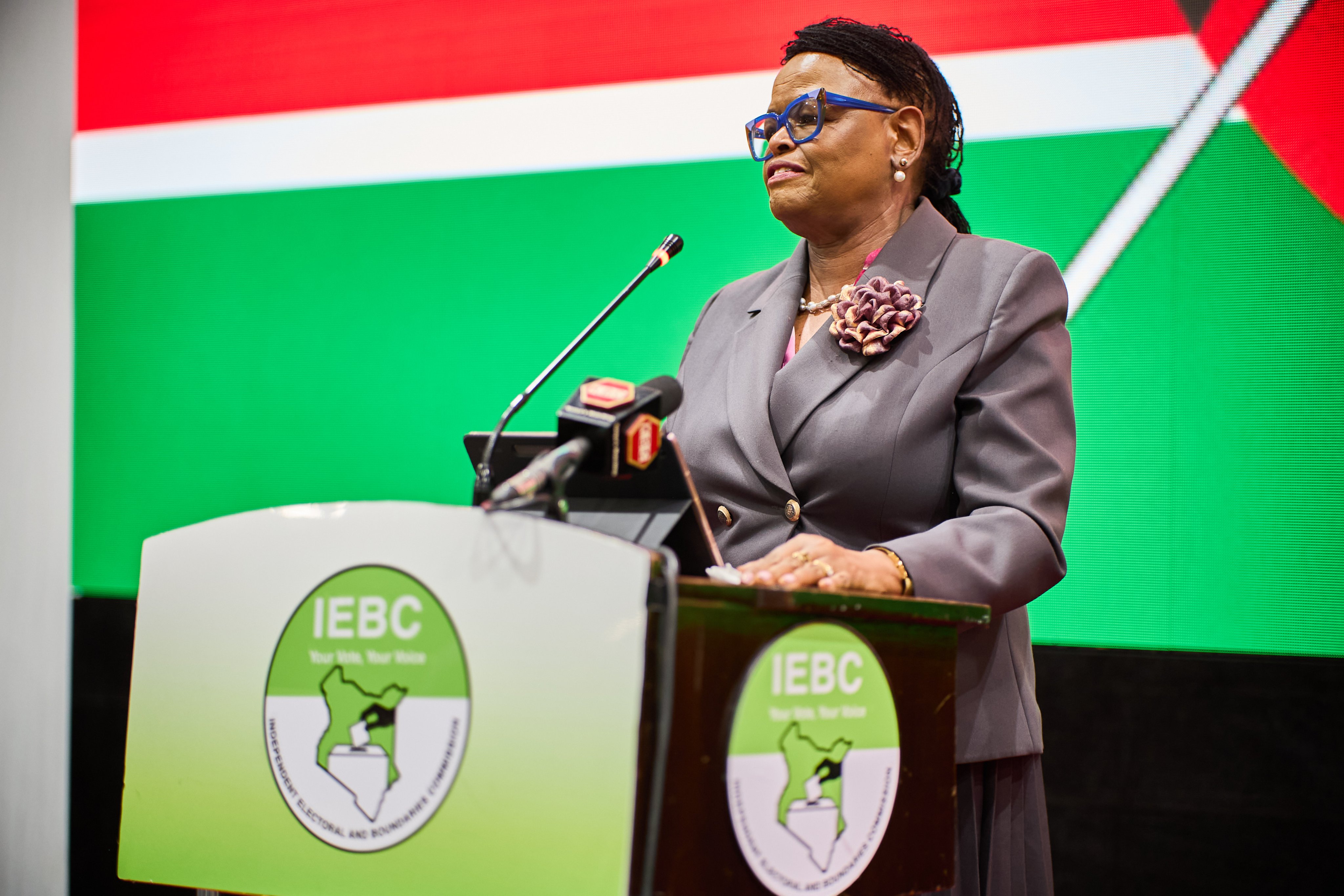
The Chief Guest Martha Koome speaking during the launch of IEBC’s Strategic Plan and Election Operations Plan
Chief Justice Martha Koome has called on the Independent Electoral and Boundaries Commission (IEBC) to firmly enforce electoral laws and the Electoral Code of Conduct ahead of the 2027 General Election, warning that political violence, intimidation and hate speech pose a serious threat to Kenya's democracy.
“Allow me at the outset to congratulate the commission, the members of the commission, the acting commission secretary CEO and the staff of IEBC for developing this forward-looking strategic plan. It took the effort of an inclusive and consultative process that brought together a broad range of stakeholders,” said Koome.
Speaking during the launch of the IEBC Strategic Plan 2024–2029 and the Election Operations Plan, Koome described the occasion as a significant milestone in strengthening democracy, improving electoral governance and enhancing citizen participation in national affairs.
“Today this launch marks a very significant milestone in our collective journey to strengthening our democracy, enhancing electoral governance and deepening citizen participation in building a better Kenya for all of us,” she said.
She praised the electoral commission for developing the strategic plan through an inclusive and consultative process involving various stakeholders, saying the approach reflected the democratic principles of transparency, accountability and shared ownership of the country's electoral future.
“Such an approach reflects the very democratic principles that the commission is mandated to uphold and demonstrates a commitment to transparency, accountability and shared ownership of our electoral future,” she added.
The Chief Justice said elections should not be viewed as a one-day event but as a continuous process that requires strong institutions, adequate resources, effective planning and a supportive legal framework.
“Elections are not merely events conducted on polling day. Rather, elections constitute a continuous process that requires strong institutions, adequate resources, effective planning and most importantly a sound and enabling legal framework,” she said.
Koome noted that credible elections are founded on four key pillars: strong laws, strong institutions, voter participation and public trust. She warned that outdated or fragmented electoral laws create uncertainty, increase disputes and undermine confidence in electoral outcomes.
“Experience from democracies around the world demonstrates that credible elections rest on four fundamental pillars: strong laws, strong institutions, voter participation and public trust,” she said.
She welcomed the IEBC's decision to prioritize strengthening the electoral legal framework and urged the commission to publicly share its proposed legal reforms so that citizens and stakeholders can actively participate in the reform process.
“I am particularly encouraged that the strategic plan identifies strengthening of the electoral legal framework as a key strategic priority. This is both timely and necessary and Kenyans want to hear and know what proposals for legal amendments you are seeking,” she said.
The Chief Justice also called on Parliament to expedite consideration of the Elections Laws (Amendment) Bill, 2026 and the Political Parties Bill, 2026, which were jointly developed by the Judiciary Committee on Elections, the IEBC and the Office of the Registrar of Political Parties.
“I take this opportunity to urge the National Assembly and the Senate to fast-track the consideration and enactment of these two proposed bills. Legal certainty is a cornerstone of electoral integrity,” she said.
According to Koome, the proposed laws seek to improve election management and streamline mechanisms for resolving electoral and political disputes, thereby enhancing legal certainty and electoral integrity.
“These bills propose legislative interventions aimed at improving the management of elections and streamlining the legal framework for resolution of electoral and political disputes,” she noted.
On the role of technology, she said digital systems have become essential tools for improving efficiency, transparency and accountability in elections but cautioned that technology alone cannot guarantee credible polls.
“Technology has become an indispensable tool for enhancing efficiency, transparency and accountability within the electoral process. However, technology alone cannot guarantee credibility,” she said.
She urged the IEBC to provide clear information on the technologies it intends to deploy and ensure adequate safeguards on data protection, cybersecurity, transparency and accountability in electronic electoral processes.
“The IEBC must therefore provide clear guidance on the deployment of technology, what technology will be deployed, what management systems will be used and how they are going to be handled,” she said.
Koome further commended the commission's commitment to inclusion, saying women, youth, persons with disabilities, minority communities and other marginalized groups must be fully involved in the electoral process and enjoy equal opportunities to exercise their political rights.
“Women, youth, persons with disabilities, minority communities and other marginalized groups must not merely be observers of democracy. They must be active participants and beneficiaries of it,” she said.
She emphasized that electoral institutions must not only be independent but must also operate transparently, professionally and within clearly defined legal and constitutional parameters to earn public confidence.
“Electoral institutions must not only be independent but must also be seen to operate transparently, professionally and within clearly defined legal parameters,” she said.
The Chief Justice stressed that credible elections require collaboration among institutions including Parliament, the Judiciary, security agencies, political parties, civil society organizations, development partners, the media and citizens.
“No institution can deliver electoral integrity in isolation. Only through sustained cooperation, mutual respect for constitutional mandates and a shared commitment to democratic values can we safeguard the credibility of our elections,” she said.
She concluded by urging the IEBC to take decisive action against candidates and political actors who engage in violence, hate speech, incitement or the use of criminal gangs, saying the normalization of political violence threatens democracy, human dignity, political freedom and the rule of law. She noted that public trust in elections can only be earned through integrity, accountability, fairness and consistent enforcement of electoral rules.
“Across the country there is a growing public concern about the increasing use of violence, intimidation, hate speech, incitement and the deployment of criminal gangs and hired goons to influence political activities and silence political rivals. These developments pose a serious threat not only to peaceful elections but also to the constitutional values of democracy, human dignity, political freedom and the rule of law,” she said.
Tags: Signs Signs Media Kenya Limited Signs Tv Signsmedia Signstv Signstvkenya Court of law Edit Editor's Pick Editors choice Iebc Iebc Commisioners IEBC Iebc Voter Judiciary Martha Karambu Koome Martha Koome Signs Media


Share this article

FELIX MAKONA
FACT FINDER AND DATA DRIVEN JOURNALIST. DATA MINING AT IT'S BEST. GET FACTS RANGING FROM MATTERS DISABILITY AND INCLUSION, POLITICS, ECONOMY, SPORTS AND GENERAL NEWS AROUND THE WORLD