

William Ruto Declares “Africa’s Time Has Come” at Africa Forward Summit in Nairobi
Politics Updated: 12 May 2026 18:05 EAT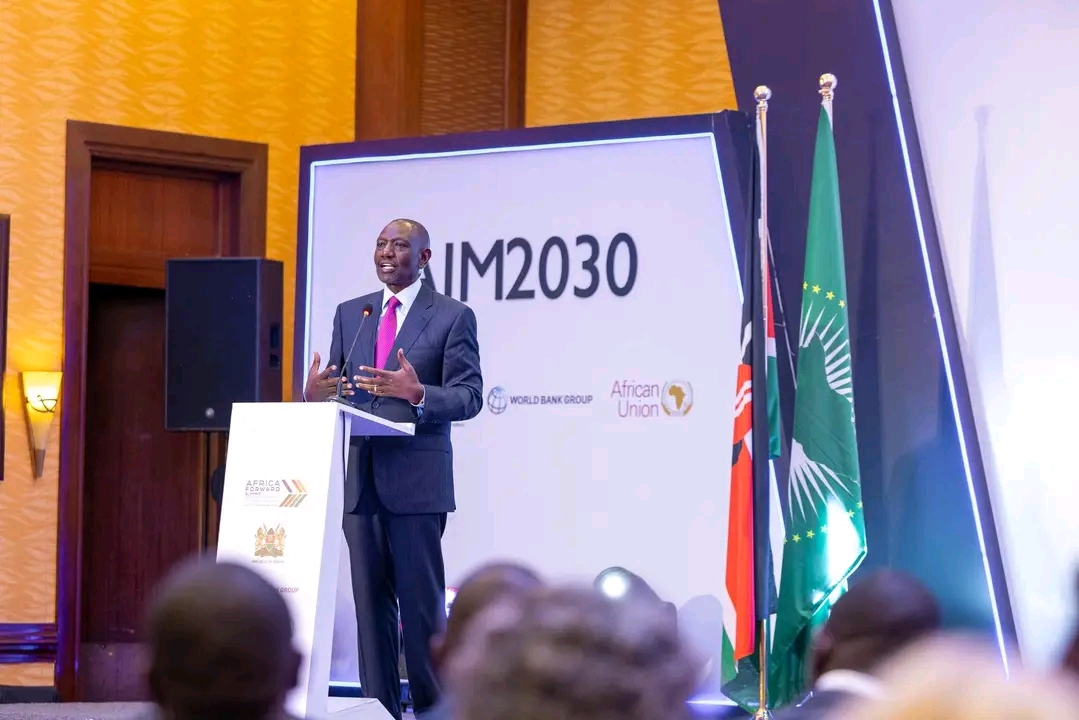
President William Samoei Ruto speaking on the second day of the Africa Forward Summit at the KICC Nairobi
President William Ruto used the Africa Forward Summit 2026 in Nairobi to deliver one of his most expansive foreign policy and economic transformation speeches yet, positioning Africa as a rising force determined to shape its own destiny in an increasingly fragmented global order. Addressing heads of state, diplomats, investors and development partners, Ruto argued that Africa’s future would depend on sovereign partnerships, economic resilience, industrial transformation and youth-driven innovation.
“Your Excellency Emmanuel Macron, President of the French Republic... Africa and France have a unique opportunity to forge a forward-looking partnership that delivers shared progress.”
Ruto said the world was entering a period of profound uncertainty marked by geopolitical tensions, climate shocks, inequality and economic instability, warning that Africa could no longer afford to remain vulnerable to external shocks and outdated dependency models. He said new partnerships must reflect equality, dignity and shared interests rather than donor-recipient dynamics.
“The foundations of international order are being reshaped by deepening geopolitical divisions, persistent conflicts, economic volatility, climate pressures, and widening inequalities.”
The President emphasized that Africa’s engagement with global powers must now shift toward mutually beneficial investment frameworks capable of unlocking growth, infrastructure and industrial development across the continent. He insisted that Africa was no longer approaching global discussions from a position of weakness.
“Our shared conviction [is] that enduring partnerships must not be built on dependency but on sovereign equality; not on aid or charity but on mutually beneficial investments.”
Ruto framed Africa as an emerging strategic force with increasing economic relevance, demographic power and geopolitical influence. He argued that the continent must be treated as an equal participant in shaping the future global order.
“Africa approaches this summit not from the margins of global affairs, but as a strategic actor in its own right.”
A major section of the President’s address focused on economic sovereignty and the urgent need for Africa to finance its own development agenda. Ruto argued that the continent possessed sufficient domestic resources but lacked the institutional structures necessary to mobilize them effectively.
“First, we must confront with honesty and urgency the question of how Africa finances its own transformation.”
He noted that Africa continued to depend excessively on foreign financing despite holding enormous domestic savings and pension reserves capable of funding transformative infrastructure and industrial projects if properly harnessed.
“Africa must increasingly finance Africa... Across our continent, enormous pools of domestic capital remain underutilized. Africa today holds more than $4 trillion in long-term domestic savings.”
Ruto argued that the greatest challenge was no longer a lack of money but the inability to structure financial systems capable of lowering investment risk and attracting long-term capital into productive sectors of African economies.
“The issue therefore is not liquidity, it is risk architecture.”
The President called for a complete restructuring of Africa’s financial systems, including stronger development finance institutions, regional capital markets and investment guarantees designed to unlock industrial growth on African terms.
“We must fundamentally restructure and strengthen Africa's financial architecture to mobilize the scale of capital required to finance this transformation on African terms.”
Ruto also criticized international credit rating systems, saying they continued to unfairly penalize African economies and raise borrowing costs despite significant economic reforms and investment opportunities across the continent.
“The bias embedded within global credit rating systems continue to penalize African economies, increase the cost of capital, and discourage long-term investment into productive sectors.”
On infrastructure, the Kenyan leader stressed that Africa could not achieve meaningful integration or industrial competitiveness without large-scale investments in transportation, logistics and regional connectivity systems linking markets across borders.
“We must accelerate investment in transport corridors, in ports, rail systems, roads, aviation, connectivity and integrated logistics ecosystems capable of binding Africa together into one competitive economic space.”
Ruto further argued that the global green transition offered Africa a historic opportunity to industrialize while simultaneously contributing to global climate solutions and clean energy development.
“Green industrialization presents our continent with an opportunity not only to contribute meaningfully to global climate solutions, but also to create jobs.”
He warned against a future in which Africa merely exported raw minerals used in green technologies while higher-value industrial manufacturing and technological innovation remained concentrated in wealthier economies.
“We cannot accept a future in which Africa simply exports raw green minerals while industrial value addition, advanced manufacturing, and technological innovation take place elsewhere.”
Turning to demographics, Ruto described Africa’s youthful population as one of the continent’s greatest strategic advantages, capable of driving innovation, entrepreneurship and industrial expansion for decades to come.
“Our youth population is not a burden to be managed. It is an extraordinary strategic advantage to be invested in.”
The President said governments must urgently shift from outdated employment models toward empowering young people to create businesses, develop technologies and lead emerging industries such as artificial intelligence and digital innovation.
“We must equip Africa’s young people not merely to seek jobs but to create enterprise, build technologies, drive industrial transformation and lead the next frontier of artificial intelligence and digital innovation.”
He praised the rapid rise of African startups and technology innovators, noting that young entrepreneurs across the continent were already transforming sectors ranging from agriculture to financial services.
“Young Africans are redefining finance through fintech, transforming agriculture through technology, and building globally competitive startups.”
On matters of peace and security, Ruto maintained that development and stability were inseparable, arguing that sustainable progress could only emerge where societies enjoyed peace, inclusion and institutional strength.
“Peace, security, and development remain inseparable foundations of sustainable progress.”
The President cautioned against relying solely on military responses to insecurity, saying conflicts across the continent were often rooted in poverty, inequality, exclusion and weak governance systems.
“Lasting peace cannot be secured through military response alone. Peace requires confronting the structural drivers of instability: poverty, exclusion, unemployment, inequality, and weak institutions.”
Ruto also mounted a strong case for reforming international governance institutions, especially the United Nations Security Council, saying Africa remained unfairly excluded from major global decision-making structures despite its population and strategic importance.
“It is both indispensable and unconscionable that a continent of nearly 1.5 billion people represented by 54 sovereign states... [is not adequately represented in] reforming global peace and security governance, particularly the United Nations Security Council.”
He argued that no international governance structure could legitimately claim fairness or democracy while entire regions remained absent from the institutions responsible for determining global security priorities.
“No global governance architecture can credibly claim to be democratic, to be representative, to be just, or fit for purpose, while a substantial part of humanity remains absent from the table where the world's most consequential decisions are made.”
According to Ruto, the continued exclusion of Africa from permanent representation on the Security Council undermined trust in multilateralism and weakened the legitimacy of international institutions.
“Such inequality erodes legitimacy, undermines credibility, and diminishes confidence in multilateral systems itself.”
The President described Security Council reform not simply as a bureaucratic adjustment but as a historic moral imperative necessary for restoring fairness and global balance in international governance.
“The reform of the Security Council is not merely an institutional adjustment. It is a moral obligation. It is a strategic necessity.”
Kenya, he said, would continue supporting the African Union’s common position demanding permanent African representation on the Security Council through the Ezulwini Consensus framework.
“Kenya therefore remains steadfast in its support for the common African position as articulated in the Ezulwini Consensus... which calls for Africa to be accorded permanent representation on the Security Council.”
Ruto repeatedly returned to the themes of dignity, fairness and African agency, insisting that the continent was not asking for favors from the international community but equitable treatment and meaningful inclusion.
“Africa does not need privilege but fairness. We don't need exclusion but inclusion.”
He called for a complete redefinition of Africa’s relationship with the world, saying future engagement must prioritize value creation, industrial growth and long-term prosperity rather than extractive economic relationships.
“We seek a new era of engagement... based not on dependency but on dignity. Not on extraction but on value creation and not on short-term transactions but on long-term shared prosperity.”
The President painted a picture of an Africa driven by confidence, innovation and self-belief, with governments and citizens increasingly determined to mobilize domestic resources and shape their own future.
“The Africa we envision is an Africa of confidence, an Africa of ideas, an Africa of innovation, an Africa of enterprise, an Africa that believes in itself, invests in its people, mobilizes its own resources, and engages the world as an equal partner.”
Ruto declared that Africa was no longer waiting for permission to rise but was increasingly prepared to influence global affairs, economic transformation and technological advancement on its own terms.
“Africa is rising, determined to shape its own destiny and increasingly prepared to shape the future of the world itself.”
As he concluded his address, the Kenyan leader framed the Africa Forward agenda as a defining continental vision rooted in sovereignty, resilience and limitless possibility rather than dependency or vulnerability.
“That is the Africa Forward agenda. An agenda grounded not on dependency but on sovereignty. Not in vulnerability but in resilience, and not in limitation but in possibility.”
The speech ended with one of the strongest declarations of African optimism and self-determination delivered during the summit, drawing applause from delegates gathered in Nairobi.
“That is the Africa whose time has come.”
Tags: Africa Forward Summit KICC Africa Freedom Edit Editor's Pick Editors choice KBB KBB Kumi Bila Break President William Ruto Ruto Ruto Quotes Signs Signs Media Signs Media Kenya Limited Signs Tv Signsmedia Signst Signstv Signstvfao Signstvkenya Signsv Ssignstv William Ruto William Samoei Ruto

Share this article

FELIX MAKONA
FACT FINDER AND DATA DRIVEN JOURNALIST. DATA MINING AT IT'S BEST. GET FACTS RANGING FROM MATTERS DISABILITY AND INCLUSION, POLITICS, ECONOMY, SPORTS AND GENERAL NEWS AROUND THE WORLD