

Two Visions, One Crucial Test: How Uhuru's Steadfast Diplomacy Meets Samia's Iron Resolve
Politics Updated: 11 November 2025 16:12 EAT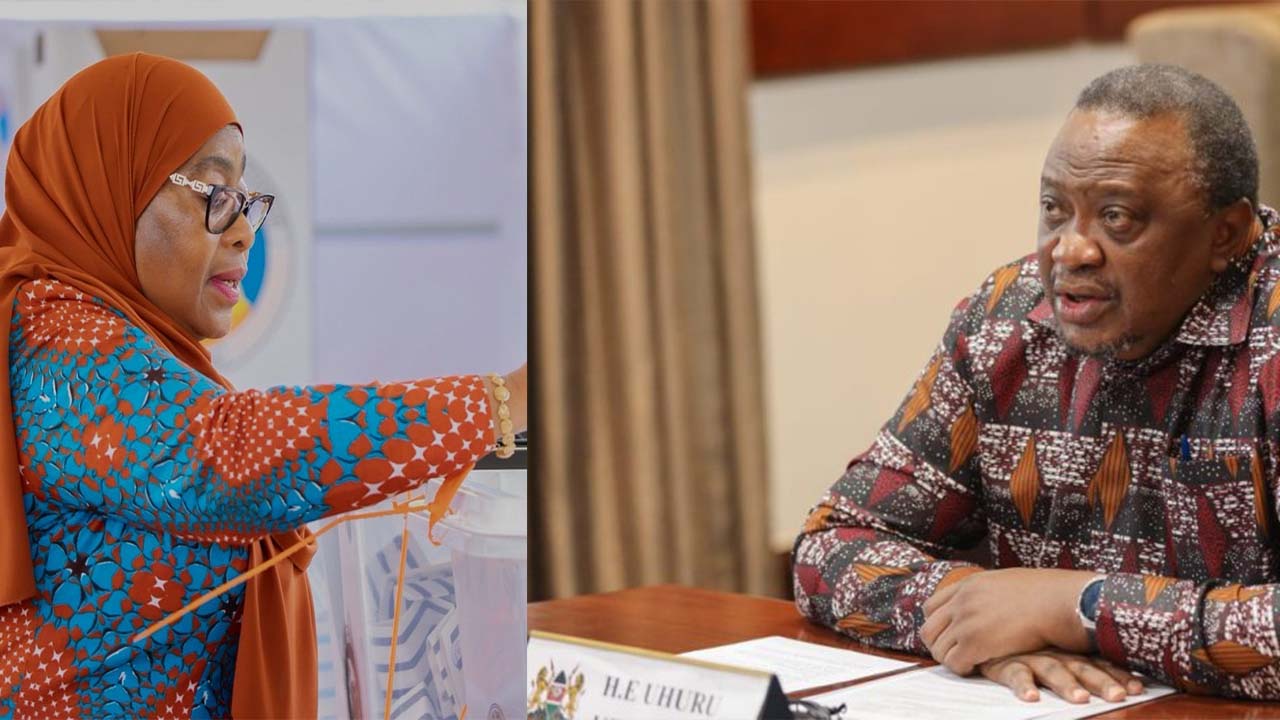
PHOTO COURTESY
By Daniel Weloba
The Champion of Engagement: Uhuru’s Approach
When Uhuru Kenyatta visited Dar es Salaam in 2019, he carried with him the message of a bridge-builder. His focus was simple: mutual growth, regional harmony, and economic interdependence.
He declared that Kenya and Tanzania’s destiny lay in partnership, in building shared markets, trade, and peace rather than mistrust.
“Our biggest concern is to build the economies of our countries, to eliminate the problems facing Kenyans and Tanzanians, and to do business.”
It was a philosophy rooted in patience and understanding. Even at moments of tension, Kenyatta preferred conversation over confrontation.
“Someone only knows where he lives… How do you tell a Tanzanian not to do business in Kenya?”
Uhuru’s approach reflected a statesman’s pragmatism: diplomacy first, sovereignty second. For him, Kenya’s regional influence was best exercised through calm engagement and the steady nurturing of bilateral trust.
The Uhuru Doctrine champions regional integration over insular nationalism, advocating for trade as the primary tool to forge unity and stability, coupled with an absolute commitment to dialogue over reliance on military defense or conflict resolution.
The Firm Hand of Suluhu: A New Era of Resolve
On Friday, 7th November 2025, during her swearing-in ceremony for a new term, President Samia Suluhu Hassan stood before the Tanzanian Parliament and vowed to “guard the nation’s peace at all costs.” That moment marked a distinct shift in tone and temperament from her earlier years of soft diplomacy.
In her address, Suluhu warned that Tanzania’s growing instability was “not caused by Tanzanians, but by foreigners from neighboring countries who seek to import unrest.”
Her words were sharp, drawing an invisible line between patriotism and infiltration.
Shortly after, Tanzanian security agencies intensified operations, detaining individuals accused of stirring protests and “foreign interference.”
Several rights organizations raised alarm, warning that such statements could endanger Kenyan nationals living and working in Tanzania by painting them as potential suspects in domestic unrest.
The President’s rhetoric resonated with a doctrine of security over openness. For Suluhu, Tanzania’s sovereignty is non-negotiable, and any external hand, however innocent, must be scrutinized. Her government’s clampdown on certain foreign-operated sectors earlier in the year was another expression of that resolve.
The Suluhu Resolve firmly prioritizes national stability before regional sentiment, characterized by a hard line against foreign involvement in local affairs and a policy of economic protectionism framed as essential for national preservation.
Rights groups, however, warn that this new firmness risks sliding into xenophobia, where suspicion replaces cooperation, and regional unity becomes collateral damage.
In Contrast: Diplomacy vs. Defence, The Meeting of Two Mindsets
The contrast between Uhuru Kenyatta and Samia Suluhu Hassan reflects a broader philosophical divide in East African leadership.
Uhuru’s diplomacy sought integration through dialogue, a willingness to shoulder misunderstandings for the sake of long-term cohesion.
Suluhu’s leadership, in contrast, draws its legitimacy from immediate control and national order, prioritizing sovereignty over supranational ideals.
Uhuru’s Diplomatic Patience
Under Kenyatta, Kenya’s approach to Tanzania was couched in respect, even amidst friction over trade or cross-border disputes. His belief was that East Africa could only thrive if its people and businesses felt free to move, trade, and interact. The Kenyan dream was regional integration anchored on trust, a shared market built by shared humanity.
Suluhu’s Controlled Confidence
Suluhu’s Tanzania has adopted a more assertive voice, one that sees openness as vulnerability.
Her administration’s crackdowns, restrictions, and rhetoric signal a leader wary of infiltration. While her approach commands respect domestically, it unsettles her neighbours, especially Kenya, whose nationals have historically been deeply enmeshed in Tanzania’s economy and workforce.
The Shadow of Nyerere’s Legacy
To fully understand Suluhu’s firmness, one must revisit Julius Nyerere, the founding father of Tanzania.
Nyerere’s philosophy, Ujamaa, was deeply nationalist yet profoundly Pan-African. He believed in self-reliance but also in unity among African nations.
Suluhu’s approach borrows Nyerere’s discipline and nationalism but lacks his open Pan-African optimism. Where Nyerere built ideological fences of principle, Suluhu builds physical and political boundaries of protection.
In essence, Uhuru’s diplomacy mirrors Nyerere’s outward-looking idealism, a belief in integration and partnership. Suluhu’s leadership, however, channels Nyerere’s inward focus on stability and control.
The difference lies in balance: Uhuru tilts toward collaboration; Suluhu leans toward consolidation.
Human Rights and Fear Among Kenyans in Tanzania
For thousands of Kenyans who live, work, or run businesses across the border, this tightening climate has turned friendly soil into uncertain ground.
Human rights organizations have voiced growing concern over Tanzanian security operations targeting “foreign agitators.”
Some Kenyans have reportedly gone missing or faced arbitrary detention. The Kenyan High Commission in Dar es Salaam has urged citizens to stay alert and comply with local laws while quietly escalating diplomatic talks for greater protection.
Business Implications
Earlier in 2025, Tanzania’s move to bar foreigners from 15 sectors, including retail, small trade, and food processing, hit Kenyan entrepreneurs hardest. For many, it symbolized a new economic nationalism where Tanzania was closing ranks.
What had once been an easy cross-border entrepreneurial path now feels riddled with legal and political hurdles.
What This Means for Kenyans Working or Investing in Tanzania
Kenyans working or doing business in Tanzania must ensure full legal compliance, from work permits to tax documentation, to avoid vulnerability under heightened scrutiny.
The Kenyan government has signaled commitment to safeguarding citizens’ rights abroad. Entrepreneurs and workers should maintain close contact with the Kenyan High Commission and local authorities.
As Tanzania recalibrates its foreign engagement under Suluhu’s administration, regulations can change rapidly. Diversifying investments and maintaining contingency plans is now essential.
Tags: President Uhuru Kenyatta Samia Suluhu Tanzania Kenya @60 Editor's Pick



Share this article

Selestine Nyongesa
Experienced and versatile writer, dedicated to using my exceptional writing and editing skills to inform and advocate. My work focuses on educating and entertaining readers on a range of topics, with a particular expertise in matters of disability.