

Ruto Launches Reparations Drive, Says Kenya Is Ending Cycle Of Protest Tragedies
News Updated: 15 June 2026 15:00 EAT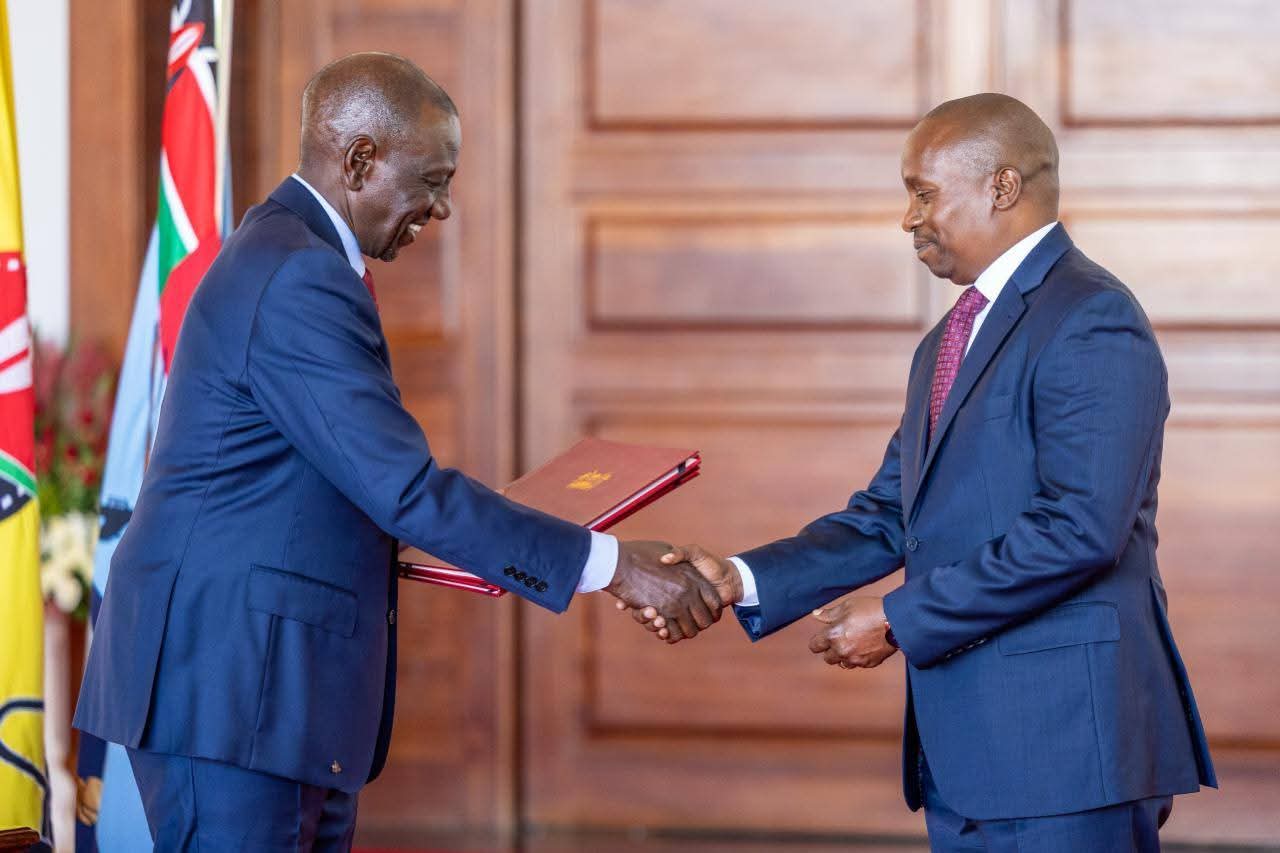
President William Samoei Ruto and Deputy President Professor Kithure Kindiki during the assent to the Division of Revenue Bill 2026, State House, Nairobi.
President William Ruto on Monday led a high-level meeting at State House, Nairobi on the Report on the Framework for Reparations for Victims of Human Rights Violations, describing it as a defining step in Kenya’s attempt to confront a long history of protest-related violence, loss, and unresolved grievances. The Head of State framed the moment as part of a broader national effort to move from repeated tragedy toward structured redress and institutional reform.
He opened the session with an apology for procedural delays in convening the meeting, while stressing that the initiative stemmed from prior political commitments. He said the process was born out of a shared conviction that the country could not continue experiencing cycles of protests, tragedy, and suffering without breaking the pattern through deliberate action.
"And party leader, I want to apologize for the late notification for this meeting. Although you have spoken and made a statement that is more profound than those who prepared to come for this meeting, this is one of the commitments we made to the Kenyan people. It was born out of a shared conviction that Kenya could not continue traveling the same painful road generation after generation, protest after protest, tragedy after tragedy. Today we take an important step towards fulfilling that commitment. I am happy that the honorable Aura is here to represent my late brother, the honorable Raila Odinga. Many have spoken about these issues over the years. Many have acknowledged the pain. Many have promised action. Today, however, we move beyond words."
Ruto said the gathering marked both a moment of progress and reflection, acknowledging the emotional weight of the process and the expectations placed on government by victims and their families. He said the initiative signaled the start of what he described as the end of a painful chapter in Kenya’s national experience.
He pointed to ongoing social and political transformation in the country, noting that citizens have increasingly demanded greater justice, inclusion, and responsiveness from institutions. According to him, the scale of public demand for change has been unprecedented and constitutionally grounded.
"I stand here pleased that we have reached this milestone, saddened by the circumstances that have made it necessary, humbled by the trust placed in us by victims and their families, and optimistic that this marks the beginning of the end of a painful chapter in our national life. Our country has been undergoing profound social, economic, and political transformation. Across Kenya, citizens have consistently expressed a desire for a future that is more just, more inclusive, and more responsive to their aspirations. Never before, however, have Kenyans expressed such a deep and widespread yearning for change and renewal. That yearning is legitimate. It is democratic and it is protected by the Constitution."
The President emphasized constitutional protections for civic expression, underscoring that the right to protest is not a state concession but a guaranteed freedom under Article 37. At the same time, he acknowledged the recurring pattern of violence and destruction that has often accompanied public demonstrations in the country.
He also addressed the dual responsibility of state and non-state actors, noting that both excessive force by security agencies and infiltration of protests by criminal elements have contributed to cycles of harm affecting civilians and law enforcement officers alike.
"The right to assemble, demonstrate, picket, and petition under Article 37 is not a favor from the state. It is a constitutional guarantee. It is one of the freedoms that define us as a democratic nation. Yet we must also confront an uncomfortable truth. For far too long, whenever Kenyans have exercised these rights, too often the outcome has been violent: injury, loss of life, destruction of property, bitterness, and division. Families have buried loved ones. Young people have carried physical and emotional scars. Businesses have been destroyed. Police officers have been injured. Communities have been left traumatized. We must also acknowledge a difficult reality. There have been instances where the response to public demonstrations has resulted in excessive use of force, violations of rights, and loss of life. Equally, there have been occasions when legitimate protests have been infiltrated by criminal elements leading to violence, looting, destruction, and harm to both citizens and law enforcement officers."
Ruto warned that repeated cycles of confrontation have weakened national cohesion, arguing that the predictable escalation from protest to violence to political blame has eroded public trust. He said the country repeatedly returns to the same unresolved issues despite widespread mourning and public outrage.
He criticized the tendency to politicize victims’ suffering, saying national tragedies should not be reduced to rhetorical tools. According to him, genuine leadership requires engaging directly with affected families and communities rather than exploiting grief for political advantage.
"The truth is that whenever this cycle unfolds, Kenya loses, citizens lose, families lose, businesses lose, the police lose, and our democracy is diminished. Then almost predictably, the blame game begins. One side points to police brutality. Another points to criminal elements and organized violence or goons. Politicians trade accusations. Television studios fill with rage and outrage. The nation mourns. And then we move on, only to repeat the cycle again. Perhaps that is—perhaps what is most painful is how easily the suffering of victims is sometimes reduced to political slogans. It is easy to exploit public grief for political gain. It is easy to seek headlines, applause, and partisan advantage. What is much harder is to sit with the families who have lost loved ones, to listen to those carrying physical and emotional wounds years after the cameras have left, to comfort those whose businesses were destroyed, whose livelihoods disappeared, and whose futures were altered forever."
The President said Kenya must reject the normalization of tragedy and instead commit to structural solutions that address root causes. He noted that successive administrations have condemned protest-related violence without fully resolving its underlying drivers.
He acknowledged the political difficulty of taking decisive action, saying leaders are often criticized whether they act or remain inactive. However, he insisted that national leadership ultimately requires prioritizing necessity over convenience.
"That is why we must resist the temptation to turn national tragedy into political theater. The lives of Kenyans are too precious, the wounds too deep for us to treat them as instruments of political competition. For decades, successive political administrations have condemned these tragedies without fundamentally resolving them. I understand why it is not easy to confront such issues. If you act, you are criticized. If you do not act, you are criticized. You are in many ways and in many respects damned if you do and damned if you don't. But there comes a point when a nation must choose action over hesitation. There comes a point when the cost of doing nothing becomes greater than the cost of trying to do something. Leadership is not about choosing what is comfortable. It is about choosing what is necessary."
Ruto detailed the policy pathway that led to the establishment of the reparations framework, citing consultations under the National Dialogue Committee and engagements within political party structures. He also referenced discussions with the late former Prime Minister Raila Odinga, which he said reinforced the need for structured compensation for victims.
He further recounted consultations with legal experts, including Professor Makau Mutua, who initially raised concerns about the implications of government acceptance of responsibility but ultimately supported moving forward in the interest of national healing.
"And so we have chosen to act not for ourselves, not for political advantage, but for Kenya. Our commitment is not in words alone. It is also in deeds. I remember very well when we discussed this both in the NADCO framework and also in the 10-point agenda UDA-ODM framework, and I remember the occasion that has been spoken to by the honorable Junet and the honorable Abu when I had occasion with the late Prime Minister Odinga, and when I told him that I had made the decision because of the consultations we had had that it was time to compensate the victims and to set up a framework for reparations. He encouraged me and he told me, 'Mr. President, this is the right thing to do and let's do it now.' I remember also that subsequently, when I issued the proclamation, Professor Makau Mutua here—who rarely asks for my time—asked for an opportunity to see me, and he came and we sat down, I think somewhere in here, and he told me, 'Mr. President, I never knew that you would agree to do this because in many respects it amounts to admission by you and government.' And so I told him, we have buried our heads in the sand for far too long and it's time for us as a nation, and for me as the leader of the nation, to stand up, own up, and do something about it."
The President confirmed that the formal process was initiated through Gazette Notice and subsequent legal instruments, including a presidential proclamation assigning responsibility to the Kenya National Commission on Human Rights. He noted that the court later directed that the commission take the lead in developing the framework.
Ruto praised the commission for completing its mandate, describing the report as a product of diligence and national service. He also commended supporting panels and stakeholders for contributing to the process, emphasizing that the framework is intended to serve victims and strengthen national reconciliation rather than advance any political interest.
"And I want to thank again Professor Makau who came to consult with me, and we agreed with him that while it was okay for us to go to court and appeal, we must also agree with the court and proceed with the process so that Kenyans can for once know that we are committed to our word. This framework represents a major milestone in protecting the rights of those harmed during protests, advancing social reconciliation, providing redress for victims, and strengthening our democracy."
He announced that the government has already allocated KSh2 billion for compensation of verified victims, including families of the deceased, injured persons, affected businesses, and law enforcement officers.
"As a demonstration of our commitment, we have already allocated Kenya Shillings 2 billion towards compensation and reparation for those who have suffered verified harm arising from protests and unrest, including affected families, injured citizens, businesses lost, and law enforcement officers injured in the course of their duties."
He cautioned that compensation should not be mistaken for full restoration of loss or pain, but rather as an official acknowledgment of harm and a step toward national healing. He also stressed that reparations are not intended to reward unlawful conduct or undermine accountability.
"This is not an isolated act. I think many leaders here have spoken to how we move together and how sometimes we treat each other not so fairly. This act that we have decided as a nation that we must do, that we must confront what has harmed many people, made us to lose lives, made us to lose property, made us to create division—we must confront as a nation. And I say it is not an act in isolation. It is part of what we are rebuilding as a nation and it goes beyond money."
Ruto concluded by calling for complementary reforms, including stronger legal protections for peaceful assembly and improved policing standards in managing demonstrations. He also highlighted emerging challenges posed by digital platforms and misinformation, urging responsible use of technology in safeguarding national unity.
When I stood in Mandera and announced the construction of the road from Isiolo to Mandera, it was the same thing that a whole part of Kenya by policy was relegated because of the policy that was said that there are parts of Kenya, you know, Sessional Paper Number 10 of 1965—a policy document of government that said some parts of Kenya will be developed and others will not. You know, these are things people take for granted, but as a result of what was done by government, huge sections of Kenya—northern part of Kenya especially—was denied the opportunity to develop like the rest of Kenya.
The meeting ended with a broader message that the reparations framework represents the beginning of a longer national journey toward justice, institutional reform, and reconciliation.
"It is still the same thing. That's why I'm saying what we are doing today is part of correcting the injustices of the past. It is the same thing when I stood three months ago in Mombasa and pronounced myself on what we are doing to redress the squatter problem in our coast region that has subjected millions of citizens to the indignity of being squatters—secondary citizens in their own country. They are treated lesser than other Kenyans. It is part of repairing our nation."
Tags: Article Azimio Protests Gen-Z protests Kindiki Kithure Kithure Kindiki Monday Protests News Article President William Ruto Signs Signs Media Signs Media Kenya Limited Signsmedia Signst Signstv SignsTV Signstvfao Signstvkenya Signsv Ssignstv William Ruto William Samoei Ruto Williiam Ruto Signs Tv Oburu Oburu Odinga Oburu Oginga
Share this article
FELIX MAKONA
FACT FINDER AND DATA DRIVEN JOURNALIST. DATA MINING AT IT'S BEST. GET FACTS RANGING FROM MATTERS DISABILITY AND INCLUSION, POLITICS, ECONOMY, SPORTS AND GENERAL NEWS AROUND THE WORLD