

Ruto Defends Education Reforms, Says 120,000 Teachers Hired in Largest Recruitment Drive in Kenya’s History
Politics Updated: 01 May 2026 21:51 EAT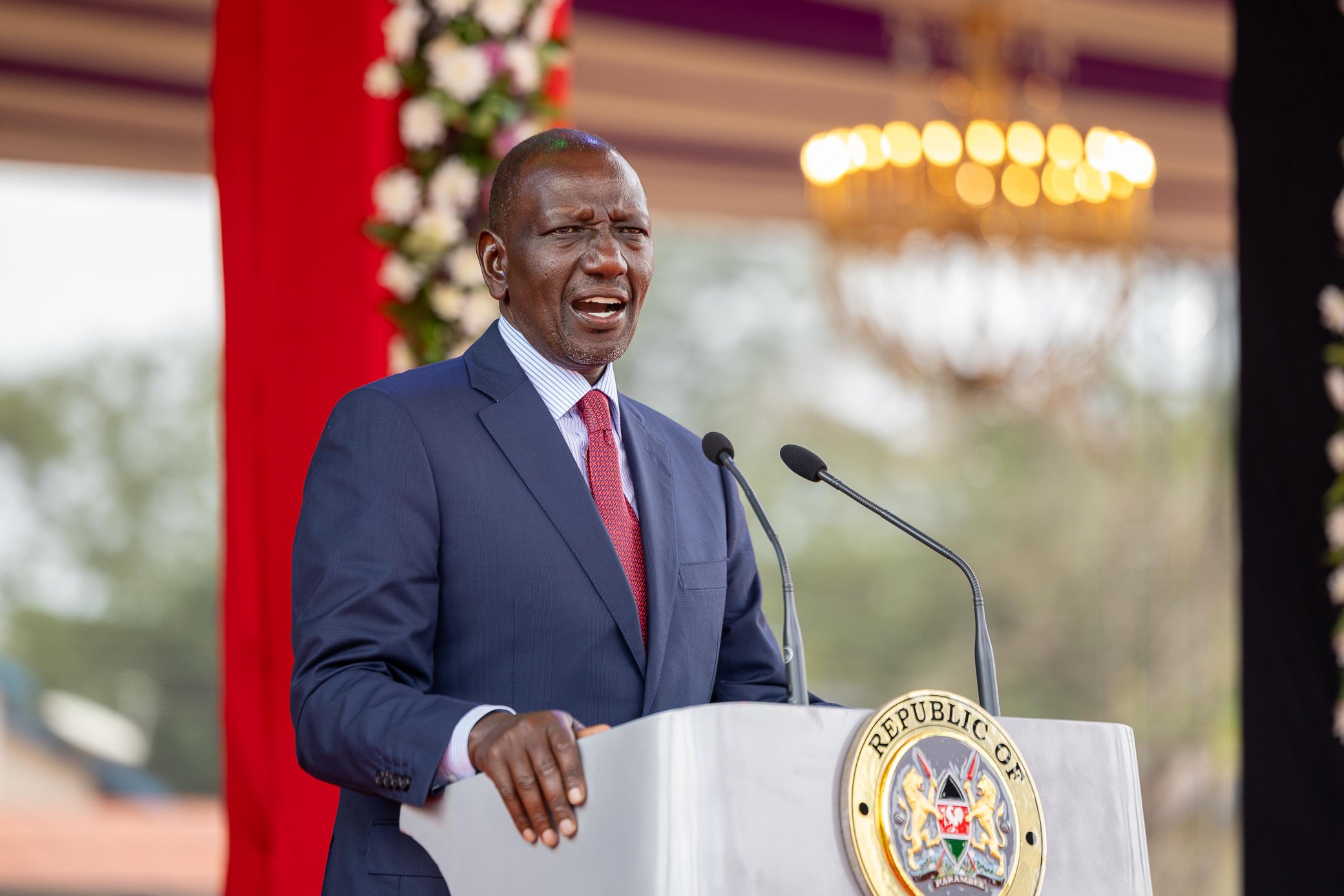
President William Samoei Ruto speaking during the 61st Labour Day celebrations at Vihiga Boys High School in Vihiga County
President William Samoei Ruto on Friday led thousands of workers, union leaders and government officials in marking Labour Day celebrations in Vihiga County, presiding over a historic national event that was held outside the capital for the first time since independence. The celebrations, staged at Chavakali High School, marked a major shift in Kenya’s approach to national commemorations, with the government seeking to decentralise such events and bring them closer to citizens across the country.
In a speech that combined policy updates with political messaging, Ruto described the moment as both symbolic and transformative, noting that for over six decades, Labour Day had remained confined to Nairobi. “Today is equally a historic moment. For the first time in the 60 years of celebrating Labour Day in independent Kenya, this national celebration is being held outside the capital city of Nairobi,” he said, drawing applause from the crowd that had gathered in large numbers.
The President emphasized that the decision to host the celebrations in Vihiga was deliberate and aligned with his administration’s broader agenda of inclusion and national reach. “And not just outside the city of Nairobi, it is being held in this great county of Vihiga County. This is a significant and transformative step, a reflection of our commitment to reach, recognize and directly involve workers across the country,” he added, framing the move as a step toward equitable national recognition.
Ruto also used the platform to acknowledge the people of the host county, thanking them for their hospitality and participation in the national event. “To the great people of Vihiga County, I extend my deepest gratitude for the warmth of your welcome and the generosity of your hospitality,” he said, as local leaders and residents cheered his remarks.
Turning to the economy, the Head of State painted a confident picture of Kenya’s macroeconomic performance, insisting that the country had remained resilient despite global shocks and domestic pressures. “By every meaningful indicator, Kenya's economy is steady, robust, and resilient,” he said, setting the tone for a detailed defence of his administration’s economic record.
He pointed to sustained economic growth as evidence of stability, noting that key indicators had remained strong even during uncertain times. “Our GDP growth has held firm above 4.6% even in the face of global uncertainty and internal disruption,” Ruto stated, positioning the figure as proof that the economy was on a steady recovery and growth trajectory.
On inflation, the President argued that price pressures had been effectively managed within acceptable thresholds, even as many economies worldwide struggled with rising costs. “Inflation has been between 2.8% and 5.6%; 6% in April remains within acceptable levels, particularly in the context of prevailing global pressures,” he explained, suggesting that Kenya had avoided extreme volatility.
He further highlighted the country’s foreign exchange reserves as a critical buffer supporting economic stability and investor confidence. “Our foreign exchange reserves, standing at US dollar 13.3 billion, provide close to six months of import cover, safeguarding our macroeconomic stability,” Ruto said, linking the reserves to Kenya’s ability to withstand external shocks.
On the strength of the Kenyan currency, the President noted that stability in the exchange rate reflected renewed confidence in the economy. “The Kenya shilling has stabilized at Kenya shillings 129 to the dollar for over two and a half years, reflecting renewed market confidence in our country,” he said, portraying the trend as a sign of sound fiscal and monetary management.
Ruto then shifted focus to the affordable housing programme, one of his administration’s flagship projects, describing it as both a social and economic intervention. “Today, more than 273,000 affordable housing units are under construction across the country and over 9,000 have already been completed and are being handed over to deserving families,” he announced, outlining the scale of the initiative.
He underscored the employment impact of the housing programme, saying it had become a major source of jobs for Kenyans across various sectors. “The affordable housing programme has already created more than 640,000 jobs, and we are firmly on course to reach our target of one million jobs under this transformative national project,” Ruto added, linking housing directly to livelihoods.
In a move aimed at increasing accessibility, the President confirmed a reduction in the deposit required for housing applications, fulfilling a promise made to labour unions. “On the matter of deposit for affordable housing units, I am pleased to confirm that the commitment I made to COTU last year has been delivered,” he said before announcing the change.
“The deposit required for application for allocation of an affordable housing unit has now come down from 10% to 5%,” he stated, a policy shift expected to lower the barrier to home ownership for many low- and middle-income earners.
On education, Ruto highlighted what he described as unprecedented investment in human capital, particularly in teacher recruitment and infrastructure expansion. “It is the same transformation we see in the education sector, where in just three years we have hired and recruited over 120,000 teachers,” he said, pointing to efforts to address long-standing shortages.
He described the recruitment drive as historic, noting that it represented the largest hiring of teachers within such a short period in Kenya’s history. “That huge shortage of teachers that existed in 2022, we have done something about it. We have hired 120,000 teachers, the single largest recruitment of teachers in Kenya in three years by any administration,” Ruto emphasized.
Beyond staffing, the President outlined ongoing infrastructure development aimed at improving learning conditions, especially in marginalized areas. “We are delivering 23,000 new classrooms, and 1,600 new laboratories are being built, particularly in underserved and rural areas,” he said, stressing the government’s focus on equity in education.
In the agricultural sector, Ruto detailed reforms intended to streamline support systems and eliminate inefficiencies that had historically disadvantaged farmers. “It is the same recalibration that is underway in agriculture, where we have established a verified digital register of our 7.2 million farmers,” he said, describing the initiative as a major structural reform.
He argued that the move had helped dismantle exploitative systems and ensured that farmers directly benefit from state interventions. “By doing so, we have eliminated middlemen and dismantled cartels, ensuring that farmers directly benefit from government support and intervention,” he added.
The President also highlighted progress in financial inclusion, particularly through the Hustler Fund, which targets small-scale entrepreneurs and underserved populations. “Some 800,000 Kenyans who were previously locked out of the mainstream financial system have now rebuilt their credit profiles,” he said, pointing to expanded access to credit.
“They can access higher microloans of up to 150,000 Kenya shillings through the bridge facility under the Hustler Fund, opening the door to opportunity, enterprise and financial inclusion,” Ruto added, linking the programme to grassroots economic empowerment.
On healthcare, the President pointed to the transition from the defunct NHIF to the Social Health Authority as a major milestone in expanding access to medical services. “We have expanded health insurance coverage from as few as 8 million Kenyans just three years ago to nearly 30.8 million today under the Social Health Authority,” he said.
He emphasized the scale of the transformation, noting that coverage had more than tripled within a short period. “This brings close to 65% of our population into the safety of care, compared to just 16% under the defunct National Hospital Insurance Fund,” Ruto stated, presenting the figures as evidence of reform success.
The President also addressed concerns from public sector workers, particularly teachers, regarding healthcare costs, assuring them of improved terms under ongoing negotiations. “These negotiations will culminate in updated agreements that guarantee a seamless zero co-payment,” he said, signaling policy changes ahead.
“Let me say it again, zero co-payment, walk-in, walk-out experience for all teachers and public officers,” Ruto declared, reinforcing the message as he concluded a speech that blended celebration, policy defence and forward-looking commitments.
Tags: Article Edit Editor's Pick Editors choice Government Of Kenya KBB Kumi Bila Break Labour Day Ministry Of Labour And Social Protection News Article President William Ruto Ruto Promises Signs Media Kenya Limited Tutam Two Term William Ruto William Samoei Ruto Williiam Ruto Willliam Ruto Francis Atwoli KBB Papa Francis Atwoli

Share this article

FELIX MAKONA
FACT FINDER AND DATA DRIVEN JOURNALIST. DATA MINING AT IT'S BEST. GET FACTS RANGING FROM MATTERS DISABILITY AND INCLUSION, POLITICS, ECONOMY, SPORTS AND GENERAL NEWS AROUND THE WORLD