
Opposition Claims Cartel Control in Kenya’s G2G Fuel Import Framework
Politics Updated: 15 April 2026 18:41 EAT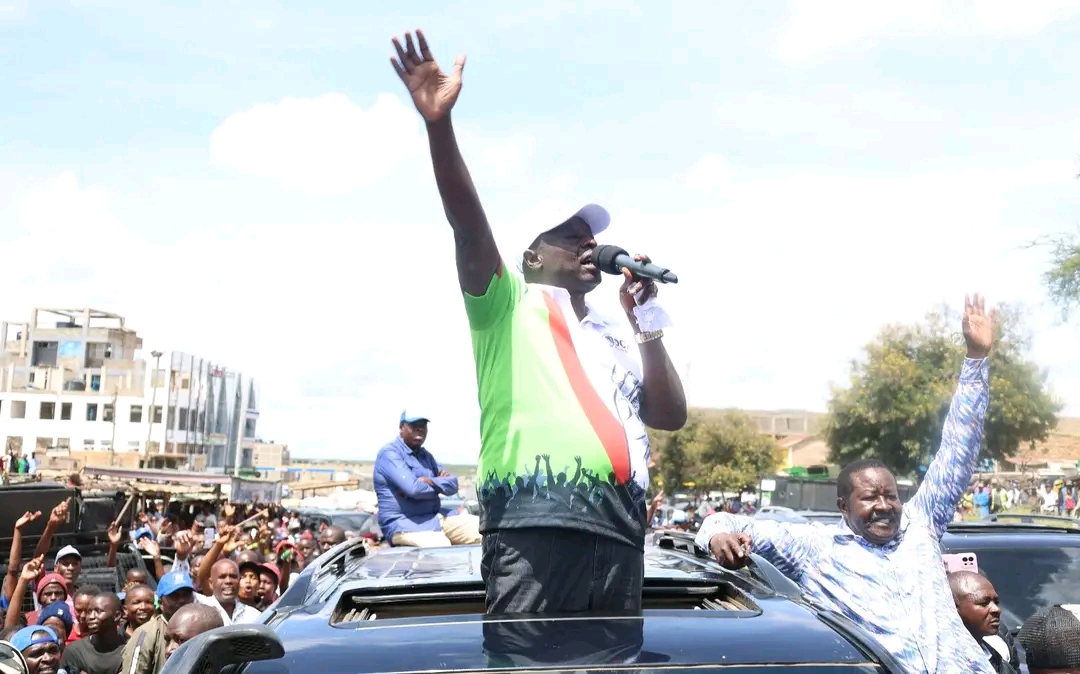
Alternative Government leaders led by DCP leader Rigathi Gachagua during a Press Conference On Fuel Crisis in Karen, Nairobi
Former Deputy President Rigathi Gachagua on Wednesday led opposition leaders in Karen, Nairobi, where they levelled serious allegations over the structure and execution of Kenya’s oil import arrangements, focusing on the government-to-government (G2G) fuel framework.
The leaders said the public had not been fully informed about how procurement decisions were made within the petroleum sector, arguing that key actors and processes were deliberately concealed from scrutiny.
Gachagua claimed the controversy involved senior state officials and politically connected actors, stating: “the team leader of this oil scandal is William Ruto, Felix Koskei and the abroad based expert, the CS for Energy and Petroleum, Mr. P.O. and a local company which is a nominee of the international oil companies (IOCs) awarded under the so-called G2G framework.”
He further alleged that external geopolitical tensions influenced domestic decision-making, adding: “while the crisis in the Middle East brought about the conflict between the USA and Iran, William Ruto saw a big business opportunity to fleece Kenyans as he has always done.”
The former Deputy President also referenced past political controversies involving the Head of State, stating: “Kenyans will recall the Brazil maize scandal of 2009 when William R was Minister for Agriculture and he was fired by the then Prime Minister, the late Right Honourable Raila Odinga. Truly, you cannot change the character of a man.”
He claimed that emergency fuel procurement processes were manipulated through state structures, saying: “William Ruto’s proxy via a letter dated 21st March 2026 confirmed their inability to supply fuel and triggered a delivery default.”
Gachagua further said the structure of supply allocation was heavily skewed, stating: “GAF Energy supplies four out of six or 67% of the monthly fuel cargos, leaving the other five oil marketing companies to supply the balance of 33% under the G2G framework.”
He argued that emergency procurement procedures were invoked under state directives, adding: “the three government officers invoked relevant provisions of the Petroleum Importation Regulations 2023 and implemented a directive issued by the National Security Council to diversify petroleum import sources beyond a single region.”
The opposition leader further detailed the procurement timeline, stating: “on 18th March 2026, the State Department for Petroleum convened a meeting of the vessel alignment committee to review the supply position and replenishment plan.”
He added that multiple firms were invited to participate, saying: “the 13 oil marketing companies were invited to submit expressions of interest for emergency supply of contingency fuel stocks for delivery between 28th and 30th March 2026.”
Gachagua noted that only a limited number responded in time, stating: “only four of the 13 oil marketing companies submitted their bids within the stipulated time frame.”
He explained that emergency contracts were then awarded under specific conditions, saying: “the award for the supply of emergency contingency stocks was duly awarded to the two lowest technically compliant oil marketing companies, subject to a quality waiver from the Kenya Bureau of Standards (KEBS).”
He further cited regulatory justification for waivers, stating: “this was in line with clause 8.1 of the Petroleum Regulations 2023 and international best practice, as seen in other countries that relaxed fuel specifications following global supply disruptions.”
Gachagua also referenced official correspondence on product standards, stating: “a letter dated 28th March 2026 granted a waiver for oxygenates, manganese, sulfur and benzene parameters in fuel specifications.”
He identified the companies awarded the emergency contracts, saying: “the following companies were awarded: One Petroleum and Oryx.”
The opposition leader argued that supply timing was central to the controversy, stating: “their supply position was to provide fuel cover for two weeks, thus ensuring product availability during the Easter holiday period.”
He then questioned the exclusion of a major supplier, saying: “GAF Energy bids be affixed to the procurement process and awarded with immediate effect.”
Gachagua added that the company submitted its bid after initial awards had already been concluded, stating: “GAF Energy submitted their bids three days later on 23rd March 2026 after the awards had been executed.”
He further argued that timing disadvantages led to rejection of certain bids, stating: “their delivery was for the 8th to 15th April 2026, which was 10 days past the preferred date range.”
Gachagua also claimed preferential treatment in procurement decisions, stating: “the bid of GAF Energy was rejected by the vessel alignment committee.”
He further alleged market dominance by a single supplier, stating: “this being William Ruto’s proxy company that supplies 80% of monthly cargoes.”
The opposition leaders said the alleged procurement structure reflected political influence within the petroleum sector, arguing that decisions were not purely technical but shaped by powerful interests.
They further claimed that emergency procurement mechanisms had been used in a way that distorted normal competitive processes in fuel importation.
The group insisted that regulatory institutions and oversight bodies should examine the full chain of decisions surrounding the G2G framework.
They also called for scrutiny of waiver approvals and committee decisions that allowed adjustments to fuel quality standards during the import cycle.
The leaders maintained that the structure of supply allocation had created an uneven market, concentrating large volumes of imports among a small number of firms.
They concluded by demanding accountability from all officials they believe were involved, insisting that the matter required independent investigation to establish responsibility.
Tags: 6G Article DCP DCP Leader Rigathi Gachagua Edit Editor's Pick Editors choice Epra EPRA Epra New Fuel Prices EPRA Fred Matiangi Fred Matiang'I Kalonzo Kalonzo Musyoka Martha Karua Ministry of Energy And Petroleum One Term One term Scandals Signs Signs Media Kenya Limited Signs Tv Signsmedia Signstv Signstvkenya United Opposition Wantam Wantam

Share this article

FELIX MAKONA
FACT FINDER AND DATA DRIVEN JOURNALIST. DATA MINING AT IT'S BEST. GET FACTS RANGING FROM MATTERS DISABILITY AND INCLUSION, POLITICS, ECONOMY, SPORTS AND GENERAL NEWS AROUND THE WORLD