

Sifuna Questions Senate Retreat On Food Safety Bill And Defends County Role
News Updated: 09 June 2026 19:38 EAT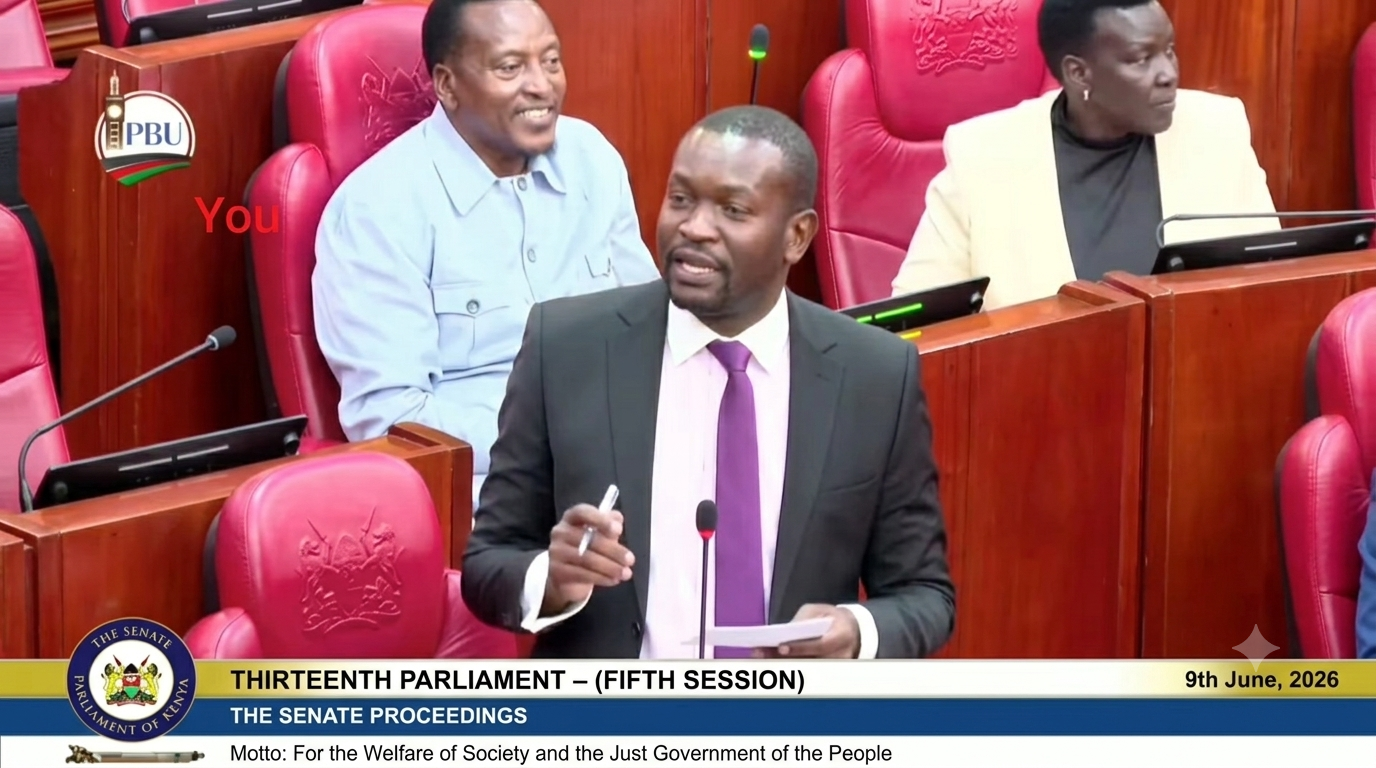
Nairobi Senator and Linda Mwananchi faction Leader Edwin Sifuna speaking during today's senatorial debate
Nairobi Senator Edwin Sifuna used his contribution in the Senate to challenge the handling of the mediated version of the Food and Feed Safety Control Coordination Bill, arguing that county governments should not be sidelined in matters directly linked to public health, licensing and local administration. Speaking during the afternoon sitting, Sifuna framed his remarks both as a legislative intervention and as an opportunity to explain parliamentary processes to students from Consolata School who were present in the chamber.
Opening his remarks, Sifuna welcomed the visiting students and said elected leaders carry responsibility for all children within their jurisdictions regardless of personal connections. He encouraged them to observe proceedings closely and continue engaging with leaders beyond the formal sitting.
“I do not have a student at Consolata, but because I am the senator for Nairobi, all of these kids who are here today are our kids. And as area senator, I'm responsible for their welfare. I want to take this opportunity to welcome you to the Senate this afternoon.”
He added that he would use the debate as a practical lesson in legislation and parliamentary work.
“I will take my remarks on the bill that is before this house. You follow a bit and then we'll have a conversation out there.”
Sifuna then turned to what he described as growing deviation from the actual business before the House. Referring to contributions made during the sitting, he argued that observers in the gallery could easily lose track of what senators were debating because of unrelated interventions and political diversions.
“What is actually before debate this afternoon is a mediated version of the Food and Feed Safety Control Coordination Bill. Everything else that you have heard has no relevance whatsoever to the conversation.”
He joked about some of the exchanges during the session and suggested visitors might have been left confused by references unrelated to food regulation.
To explain the matter before the House, Sifuna broke down how mediation works when legislation moves between Parliament’s two chambers. He told the students that Bills can originate in either House and once amendments are introduced, disagreements may require formal mediation.
“So a mediated version of the bill basically means that it is legislation that both houses have to pass first. It can either originate in the National Assembly or in the Senate, and then when it comes to the other house, the other house can make amendments.”
According to Sifuna, the Senate had inserted amendments recognising county governments and county departments as competent authorities in food and feed safety regulation because senators considered counties essential actors in implementation.
“We in the Senate felt that the county governments have a role to play in the control of food and feed safety.”
He linked that position to the constitutional mandate of the Senate.
“If you look at Article 96 of the Constitution, our primary responsibility is to take care of the interest of counties and their governments.”
The Nairobi senator was particularly critical of the mediation outcome and questioned whether Senate negotiators had defended the institution’s position strongly enough. He disclosed that the mediation committee reportedly met only once and ultimately agreed to remove the Senate amendment.
“There was only one sitting of this mediation committee, and it was to agree that we drop the Senate amendments.”
Sifuna said he was uncomfortable celebrating mediation outcomes where Senate proposals disappear entirely.
“We send the teams from the Senate to put our foot down in these mediations with the National Assembly.”
He questioned why concessions seemed to flow in one direction and connected the issue to ongoing disputes over county funding.
“How are we always the ones expected to back down?”
Drawing comparisons with revenue allocation debates, Sifuna argued that promises previously made regarding county allocations had not been honoured and suggested the Senate should become more assertive during negotiations.
Turning back to substance, Sifuna defended county participation in food safety oversight using practical examples from everyday governance. He argued that county governments already regulate food businesses and respond to public health emergencies.
“If you look at the licensing regime, just to open that kiosk that somebody says they go to eat matumbo and chapati, it requires licensing by the county governments.”
He continued:
“When there is an outbreak of disease here, it is expected that our county governments are the ones to coordinate efforts to ensure that people receive treatment.”
Sifuna maintained that excluding counties from food control structures ignored the realities of devolved government.
The debate later shifted briefly after another senator highlighted Consolata School’s historical legacy and inclusivity. During a point of information, the House was reminded of the school’s role in admitting the children of Raila Odinga during a politically difficult period.
“It is only the Consolata School that admitted Rosemary Odinga and admitted Junior Odinga.”
The senator praised the school for standing against discrimination and preserving values of inclusion.
Sifuna accepted the intervention humorously and noted that he had initially expected information connected directly to the Bill but welcomed the historical context.
As he concluded, Sifuna broadened the discussion to education and youth engagement, saying public conversations about schools should include students themselves. Recalling a visit to a school in Makadara, he said students often raise issues adults overlook.
“One of the things I learned… is that we also need to listen to these students.”
He shared an example from discussions with students.
“They told me, ‘Sifuna, please go to the Senate and tell the Senate that we want our hair to be pleated.’”
Sifuna argued that what may appear to adults as minor concerns can reflect wider questions about student welfare and school environments.
“Let's learn to listen to these young people. They might give you a perspective that you have not seen in order for us to be able to resolve this crisis.”
He ended by saying he would continue engaging the visiting students outside the chamber as part of his responsibility as Nairobi Senator.
Tags: Article Edwin Watenya Sifuna News Article Sifuna Signs Signs Media Signs Media Kenya Limited Signs Tv Signsmedia Signst Signstv Signstvkenya Signsv Sports Article The senate The senate debates


Share this article

FELIX MAKONA
FACT FINDER AND DATA DRIVEN JOURNALIST. DATA MINING AT IT'S BEST. GET FACTS RANGING FROM MATTERS DISABILITY AND INCLUSION, POLITICS, ECONOMY, SPORTS AND GENERAL NEWS AROUND THE WORLD