

Finance Bill 2026: Mbadi Unveils Fiscal Shift As Government Bets On Private Capital And Economic Resilience
News Updated: 11 June 2026 23:13 EAT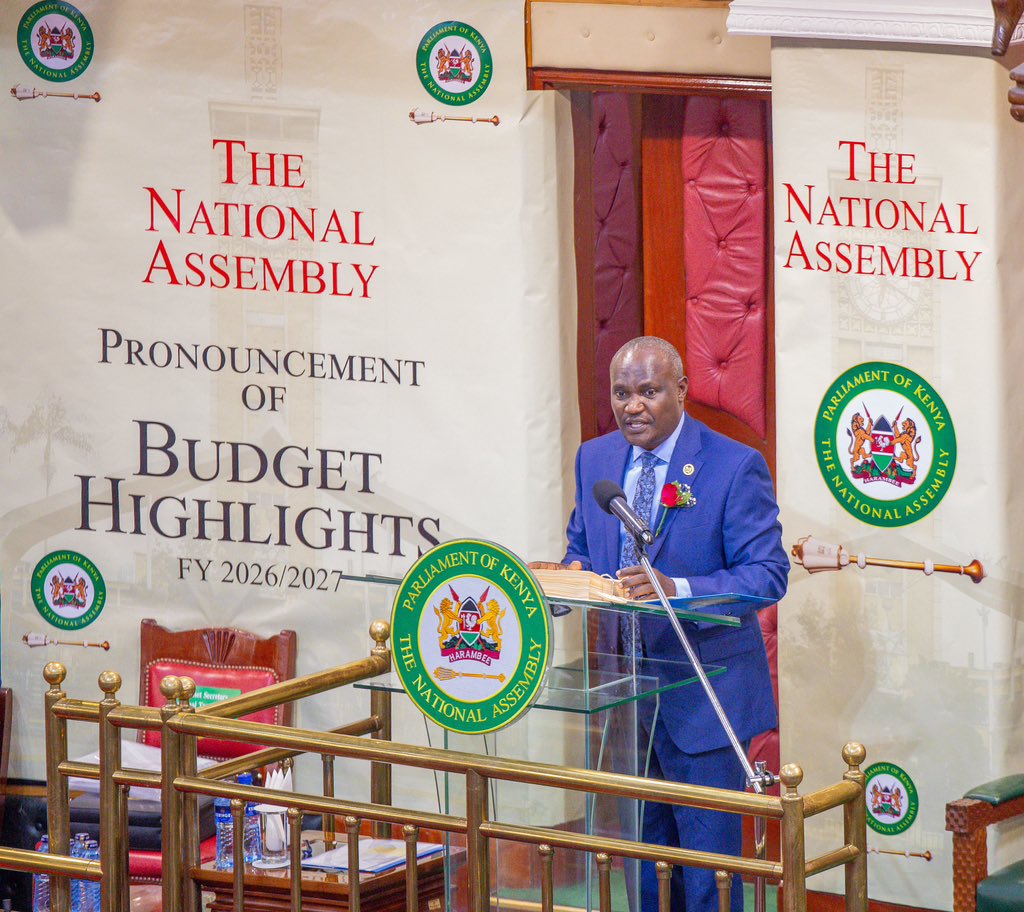
Cabinet Secretary for Treasury Hon. John Mbadi when he delivered the finance bill first reading to the national assembly this evening
Treasury Cabinet Secretary John Mbadi told the National Assembly that the 2026/27 budget is designed to sustain targeted interventions aimed at accelerating youth job creation, growing investment and trade, and strengthening Kenya’s economic resilience amid global uncertainty. The government selected the theme “Sustaining the Bottom-Up Economic Transformation Agenda for Resilient and Inclusive Growth” to reflect current economic realities and national priorities.
“Sustaining targeted interventions better in order to accelerate job creation for our youth, grow investment, and trade, and deepen economic resilience. Accordingly, Mr. Speaker, we chose the theme of the financial year 2026/2027 budget as sustaining the bottom-up economic transformation agenda for resilient and inclusive growth amid global uncertainty. This theme aligns with the current challenges and priorities of the government.”
Public concerns over the fiscal environment were acknowledged alongside an emphasis on prudence in public resource management. Ministries and agencies are expected to tighten expenditure prioritisation under narrowing fiscal space and strengthen discipline in programme execution.
“And Mr. Speaker, as we move forward in implementing the government's transformation agenda, we remain mindful of all the concerns raised by Kenyans on the prevailing fiscal environment and the need for continued prudence in the management of public resources. The current fiscal position that is characterized by narrowing fiscal space calls for careful prioritization and disciplined execution of government programs.”
Kenya’s infrastructure financing gap was presented as a key constraint, estimated at about USD 5 billion annually. The fiscal framework is increasingly viewed as insufficient to fund large-scale infrastructure solely through borrowing and taxation without deepening debt vulnerabilities.
“Mr. Speaker, let me speak plainly about the fiscal reality we face. Kenya's infrastructure financing deficit stands at approximately 5 billion US dollars every year. That's about 650 billion Kenya shillings. Our development budget while growing cannot close that gap alone. The era of financing every road, every power line, and every dam through government borrowing and taxation is over. Not because we lack ambitions, but because we have learned from the consequences of that model. Debt financing infrastructure has left us with more debt service obligations that crowd out the very spending our people need most on health, education, and social protection.”
A shift in infrastructure financing strategy was outlined, moving away from sovereign borrowing toward expanded public-private partnerships and greater reliance on the National Infrastructure Fund to mobilise private capital.
“So, Mr. Speaker, we are going to build better. We are shifting from a model where government borrows to build to enhanced use of public-private partnerships and the recently established National Infrastructure Fund in funding priority infrastructure through private sector finances. That is the foundation on which this government's infrastructure program rests.”
The Rironi–Mau Summit Expressway was highlighted as a flagship example of blended financing involving domestic pension capital and international investors, marking a shift in Kenya’s infrastructure development model.
“Mr. Speaker, the Rironi–Mau Summit expressway stands as proof. Construction of the expressway is now underway and Kenyans will be driving on a modern four to six-lane expressway once completed. What makes this project truly historic is not the speed of delivery. It is how it was financed: through the participation of the National Social Security Fund, both as a debt and equity investor alongside international investors. A major national highway is being built with Kenyan capital by Kenyan workers and for the Kenyan people.”
The National Infrastructure Fund is positioned to scale up investment in major projects by leveraging privatisation proceeds, pension resources and climate-linked financing instruments.
“Beyond the Rironi–Mau Summit project, the government will continue executing an ambitious infrastructure development plan through the National Infrastructure Fund. The fund will leverage resources from privatization proceeds from mature national assets to attract private capital, domestic pension funds, and climate finance.”
Global economic conditions were described as increasingly uncertain, with geopolitical tensions disrupting energy supply chains and key maritime routes, including the Strait of Hormuz, exerting pressure on prices.
“Ongoing conflict in the Middle East has disrupted critical energy infrastructure and major shipping routes, including the Strait of Hormuz, thereby exerting upward pressure on prices of energy and food.”
Global growth projections were revised downward, reflecting weaker momentum compared to previous years amid persistent geopolitical instability.
“Against this backdrop, global growth is therefore projected to slow down to 3.1% in 2026 and 3.2% in 2027 from the average of 3.4% in both 2024 and 2025.”
Despite external pressures, Kenya’s economy has demonstrated resilience, supported by policy stability, structural reforms and sectoral diversification over recent years.
“Notwithstanding the challenging global environment, the Kenyan economy has remained largely resilient and the economy grew at an average of 5% in the period 2022 to 2025, outperforming the average global growth and that of Sub-Saharan Africa. This performance reflects sound macroeconomic policy management, sustained structural reforms and increasing diversification of the economy.”
Inflationary pressures were linked primarily to global energy costs, although overall price stability remained within the target range under current policy conditions.
“Macroeconomic indicators remain broadly stable despite emerging external pressures. Overall inflation increased to 6.7% in May 2026 due to higher energy prices arising from elevated global oil prices but remained within the target range.”
Temporary fiscal interventions were introduced to cushion households from fuel price shocks through adjustments in tax policy and the use of stabilisation funds.
“In April 2026, the government deployed targeted stabilization measures to cushion consumers from the full impact of rising global fuel prices. These interventions include use of resources in the Petroleum Development Levy Fund and lowering VAT on petroleum products for three months from 16% to 8%.”
Monetary easing has contributed to improved credit conditions, with declining interest rates supporting private sector lending and economic activity.
“Monetary conditions have eased considerably following a reduction in the Central Bank Rate from 11.25% in December 2024 to 8.7%. Credit to the private sector expanded significantly while lending rates continued to decline.”
External accounts remain under pressure from import costs and remittance dynamics, although foreign exchange reserves continue to provide a strong buffer against shocks.
“The external sector remains resilient despite emerging risks. Official foreign exchange reserves remain adequate and continue to provide a buffer against short-term domestic and external shocks while the exchange rate has remained broadly stable.”
Fiscal consolidation remains central to medium-term planning, with a structured reduction of the budget deficit anchored on revenue mobilisation and expenditure reforms.
“The fiscal policy stance for financial year 2026/2027 and the medium term is anchored on a fiscal consolidation strategy that advances the priorities of the bottom-up economic transformation agenda while safeguarding debt sustainability and provision of essential public services.”
The budget outlook is framed around structural reforms, economic stability and targeted investments aimed at strengthening resilience and broadening inclusive growth outcomes across the economy. :::
Tags: Signs Media Kenya Limited Signsmedia Signstvkenya CS MBADI Felix Makona Finance Bill National Treasury Signs Signs Media Signs Tv Signst Signstv SignsTV Signsv Ssignstv Treasury County Government Of Nairobi Edit Editor's Pick Editors choice Finance Bill 2026 Government Of Kenya Governors John Mbadi National Government



Share this article

FELIX MAKONA
FACT FINDER AND DATA DRIVEN JOURNALIST. DATA MINING AT IT'S BEST. GET FACTS RANGING FROM MATTERS DISABILITY AND INCLUSION, POLITICS, ECONOMY, SPORTS AND GENERAL NEWS AROUND THE WORLD